IEC 60947-2 vs UL 489: What MCCB Buyers Must Confirm Before Export
Yayın tarihi: Yazar: Rachel
A molded case circuit breaker that is fully certified to IEC 60947-2 can still be rejected on a North American project. That is not a technicality or a paperwork formality — the two standards are built on different testing philosophies, and compliance with one does not imply compliance with the other.
For manufacturers, panel builders and distributors moving equipment between markets, this is one of the most expensive misunderstandings in LV procurement. It surfaces at inspection, after shipment, when it is far too late to fix cheaply. This guide sets out where the two standards actually diverge and what to confirm at enquiry stage rather than after delivery.
Two Standards, Two Philosophies
The difference is not that one is stricter than the other. It is that they ask different questions.
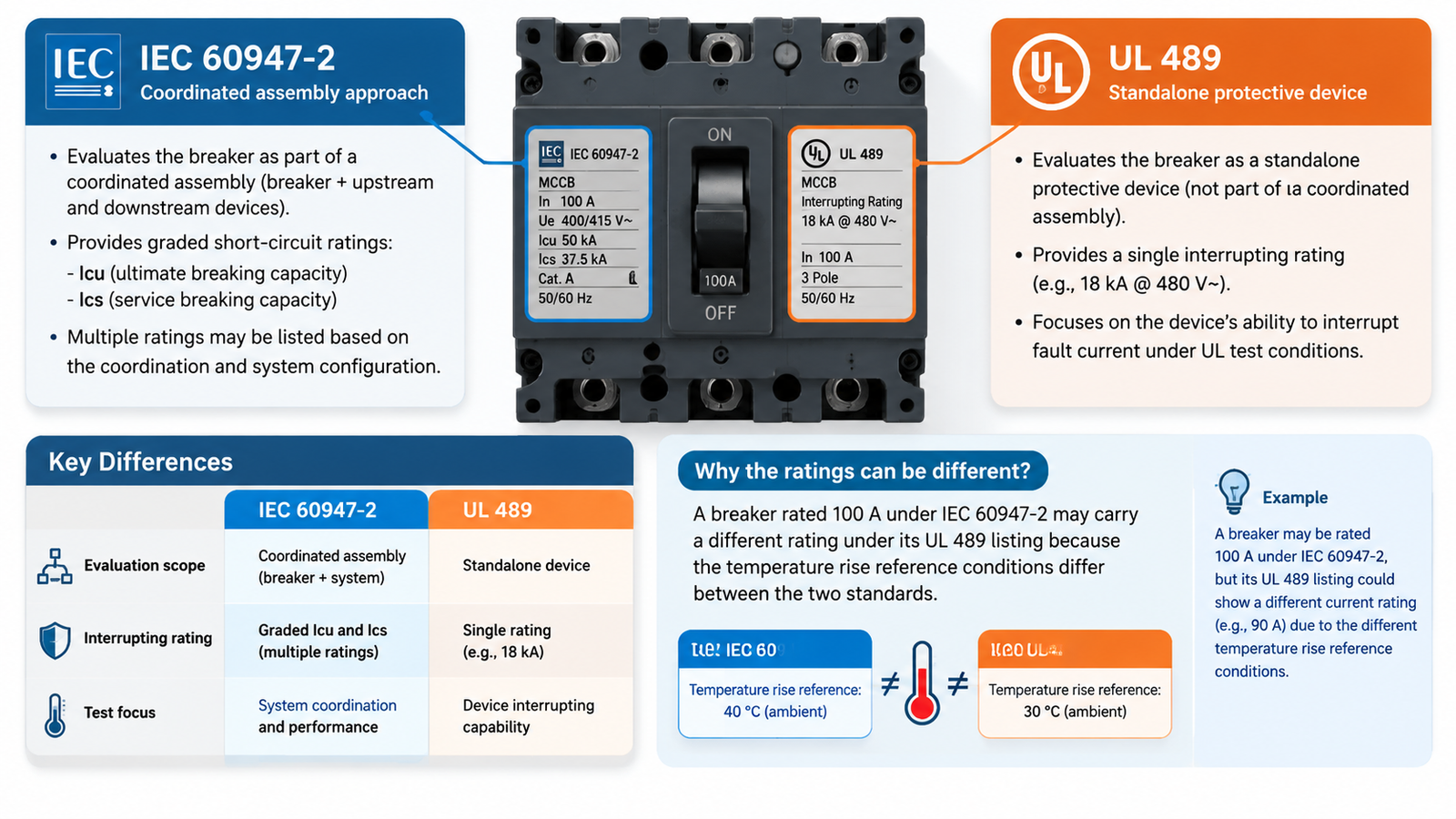
UL 489 evaluates the breaker as a standalone protective device. It asks: can this component, on its own, interrupt its rated fault current and protect the circuit it feeds? The assessment is component-level, built around worst-case test scenarios and a fixed verified interrupting rating.
IEC 60947-2 treats the breaker as part of a coordinated assembly. It asks: how does this device behave with the others around it? The standard defines graded performance levels — Icu and Ics — explicitly supports coordination studies, and leaves the engineer more freedom in configuring protection.
Hence the practical consequence: an IEC-certified design is usually arrived at through a coordination study, whereas a UL-based design leans primarily on device-level certification.
Where the Requirements Diverge
Criterion
IEC 60947-2
UL 489
Primary regions
Europe, Asia, Middle East, Latin America, Africa
USA and Canada (with CSA)
Voltage scope
Up to 1000 V AC / 1500 V DC
Up to 600 V AC (typical)
Breaking capacity concept
Graded: Icu (ultimate) and Ics (service, as % of Icu)
Single interrupting rating
Short-circuit test sequence
O–t–CO–t–CO
O–CO
Power factor at test
Lower power factor on high faults, giving higher peak asymmetrical current
Different test power factor assumption
Overload calibration
Stated tolerance on thermal trip
Calibration at defined multiples of rating
Short-time withstand
Icw defined explicitly, enabling Category B time selectivity
Series ratings via tested combinations
Ambient reference
Different temperature-rise reference conditions
Different reference conditions, which is why the same frame can carry a different rated current in each market
Marking
CE marking, IEC reference
UL listing mark and file number
One consequence surprises buyers repeatedly: a breaker rated 100 A under IEC may carry a different rating under its UL listing, because the temperature-rise reference conditions differ. The nameplate is not wrong — it is two different answers to two different questions. When reading a dual-certified device, read each marking block separately and apply the one that governs your market.
Why the Test Sequences Are Not Equivalent
IEC 60947-2 uses an O–t–CO–t–CO sequence: open, then a close-open, then another close-open, with time intervals between. UL 489 uses a single O–CO. That structural difference alone means the two tests do not produce interchangeable results.
The lower test power factor used in IEC testing for high fault currents also means higher peak asymmetrical currents, which is why some engineers regard the IEC test as the more severe one at the same RMS rating. Arguing about which is “harder” misses the point: neither certificate answers the other standard’s question, so equivalency arguments rarely survive an inspection.
Regional Requirements at a Glance
Market
Standard typically required
Note
USA / Canada
UL-based listing per project and AHJ requirements
Confirm with the authority having jurisdiction before procurement
European Union
IEC 60947-2
CE marking is not a substitute for a North American listing
United Kingdom
IEC 60947-2 aligned product approval
Confirm current national requirements
Australia / New Zealand
IEC-aligned requirements
Confirm current national requirements
Middle East
IEC 60947-2 commonly required
Often with additional utility or consultant approvals
Latin America
Varies; IEC-dominant, some UL influence
Check per country and per project
China
GB 14048.2 (harmonised in structure with IEC 60947-2)
GB certification alone does not satisfy CE or UL requirements
How to Read a Certified Nameplate
A certified MCCB nameplate is dense, and the fields you need differ depending on which regime governs your installation.
Field
What to check on the IEC side
What to check on the UL side
Voltage
Rated operational voltage Ue, and rated insulation voltage Ui
Listed voltage — if lower than the IEC marking, the listed value governs North American use
Current
Rated current In at the stated ambient reference
Listed ampere rating, which may differ from the IEC figure at the same frame size
Kırılma kapasitesi
Icu and Ics, with Ics expressed as a percentage of Icu
Interrupting rating at the listed voltage
Utilisation / category
Utilisation category, and Icw where the device is Category B
Whether series ratings apply, and with which tested combinations
Two fields are routinely skipped and routinely cause trouble. The first is frequency: a device type-tested at 50 Hz is not automatically covered for a 60 Hz market, and several export markets run 60 Hz. The second is Ics as a percentage of Icu — a device advertising a high Icu with a low Ics ratio is effectively a single-use device at high fault levels, which matters on any circuit expected to remain in service after a fault.
Electronic Trip Units Carry Their Own Requirements
A breaker’s main type test certificate does not automatically cover the trip unit fitted to it. Electronic trip units introduce additional requirements — accuracy, electromagnetic immunity, and behaviour under abnormal supply conditions — which sit alongside the device certificate rather than inside it.
In practice that means the ETU should have its own compliance documentation, covering EMC immunity and, where the device communicates with a SCADA or BMS system, the relevant communication and cybersecurity expectations. If the trip unit is supplied or substituted separately from the breaker, treat its documentation as a separate line item and check that the combination is within the tested configuration.
The Dual-Certification Route
Manufacturers serving both markets typically test to IEC 60947-2 first and then complete the separate UL evaluation. Some dielectric and endurance data may overlap, but interruption testing is not transferable between the regimes — each has its own procedures, marking rules and acceptance criteria. Dual certification reduces stocking complexity for global projects, but it adds cost and lead time, and it does not remove the need to read the nameplate carefully.
The key rule for dual-certified devices: the IEC voltage marking and the UL voltage marking are not interchangeable. If a breaker is marked 690 V under IEC and a lower value under its UL listing, the lower listed value governs North American use.
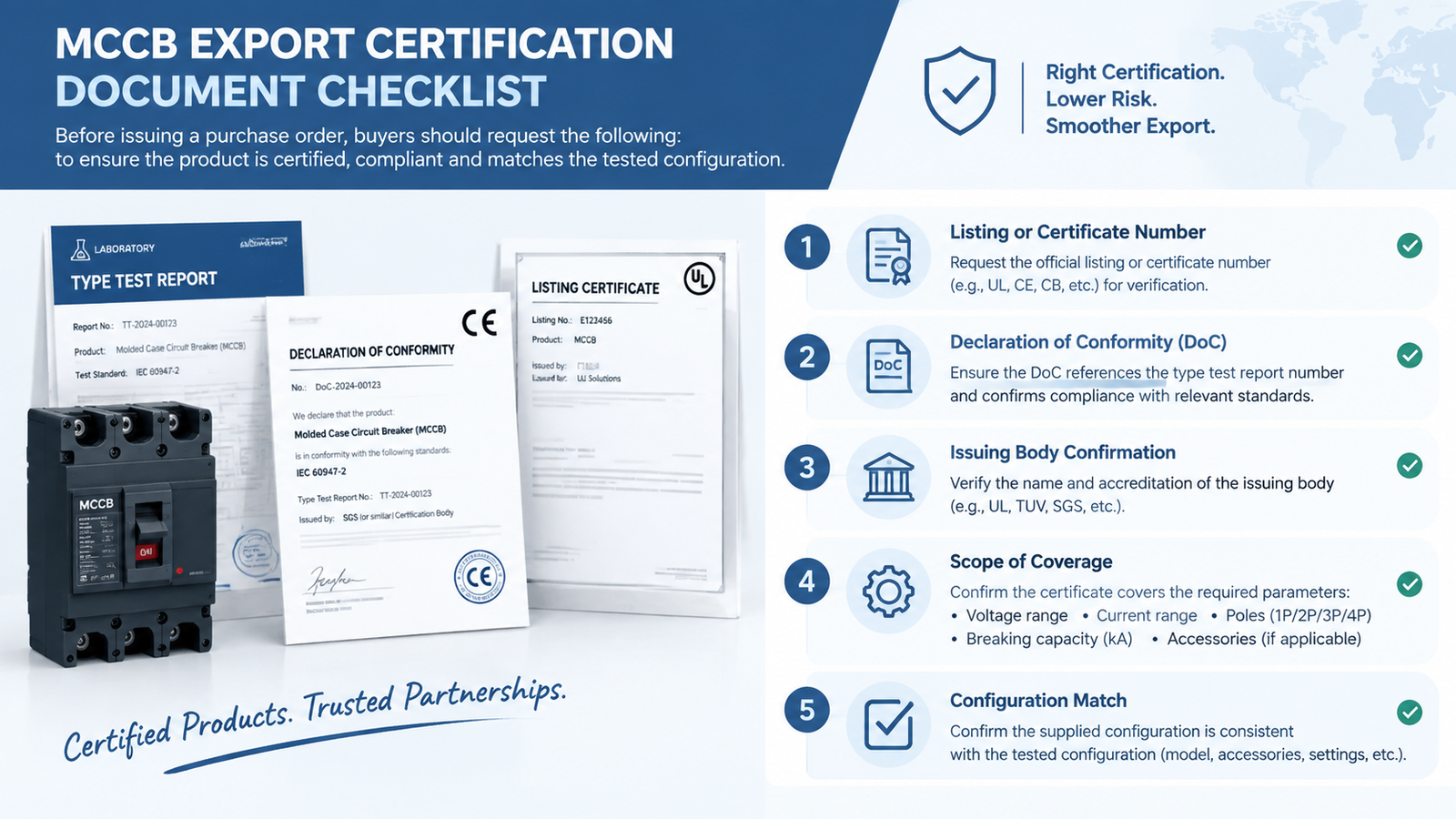
What Buyers Should Request Before Issuing a Purchase Order
The exact listing file or certificate number — requested before the order is placed, not after the goods ship.
A Declaration of Conformity that references the type test report number and the specific product variants it covers.
Confirmation of which body issued the certificate. Independently witnessed type tests carry considerably more weight than self-declaration.
The scope of the certificate — voltage, current range, pole count, breaking capacity, and whether accessories are included.
Confirmation that the configuration being supplied matches the configuration tested. Field-fitted non-OEM accessories and trip unit substitutions can invalidate certification, because the certificate applies to a specific tested configuration.
Mistakes That Cost Projects Money
Assuming an IEC certificate covers North America. It does not. This is the single most expensive assumption on the list.
Treating CE marking as a global passport. CE addresses the European Economic Area; it says nothing about UL listing.
Assuming GB or other national certification is equivalent to IEC or UL. Harmonisation of structure is not equivalence of acceptance.
Ordering accessories separately without checking listing scope. A non-OEM accessory can take a listed device out of its certified configuration.
Mixed-standard bills of materials. In global projects, EPC specifications, local code and insurer requirements should be aligned in one review, not discovered separately on site.
Discovering an additional requirement late. Where a project is financed, refinanced or insured by foreign stakeholders, they may impose certification requirements beyond local code.
Sık Sorulan Sorular
Can an IEC 60947-2 certified MCCB be used in the United States?
Not on the strength of the IEC certificate alone. North American installations generally require a UL-based listing appropriate to the application, and the authority having jurisdiction makes the final determination. Confirm the required listing before procurement.
Why is the same breaker rated differently under IEC and UL?
Because the two standards use different reference conditions — including different ambient and enclosure assumptions for temperature rise. A frame rated 100 A under IEC conditions may carry a different rating under its UL listing. Read each marking block separately and apply the one that governs your market.
Is CE marking equivalent to UL listing?
No. CE marking addresses the requirements of the European Economic Area. It is not a substitute for a North American listing and will not satisfy a UL requirement.
What is the difference between Icu and the UL interrupting rating?
Icu is the ultimate breaking capacity in the IEC framework, paired with Ics (service breaking capacity) expressed as a percentage of Icu. UL 489 uses a single interrupting rating concept. They are derived from different test sequences and cannot be directly substituted for one another. See our article on kopma kapasitesi (Icu/Ics) for the IEC definitions.
Can adding an accessory invalidate a certification?
It can. Certification is granted to a specific tested configuration. Field-fitted accessories, trip unit substitutions and changes outside the original test scope may fall outside the certificate. Check the listing scope before fitting anything not supplied with the device.
What should I ask for in the documentation pack?
The listing or certificate number, a Declaration of Conformity referencing the type test report, the issuing body, and the exact scope of coverage — voltage, current range, poles, breaking capacity and accessories.
Confirm the Standard at Enquiry, Not at Inspection
The cheapest moment to resolve standard compliance is when the enquiry goes out. At that point you can still ask for dual certification, still adjust the specification, and still align the EPC, insurer and local code requirements in a single review. After shipment, every option is expensive.
Sourcing MCCBs for a specific market? Tell us the destination and the applicable standard at the enquiry stage and we will confirm what documentation we can supply. Contact our engineering team.
<p>Shunt trip, undervoltage release, auxiliary contacts and motor operators compared - what each MCCB accessory actually does, when to specify it, and the checklist to order the right one first time.</p>
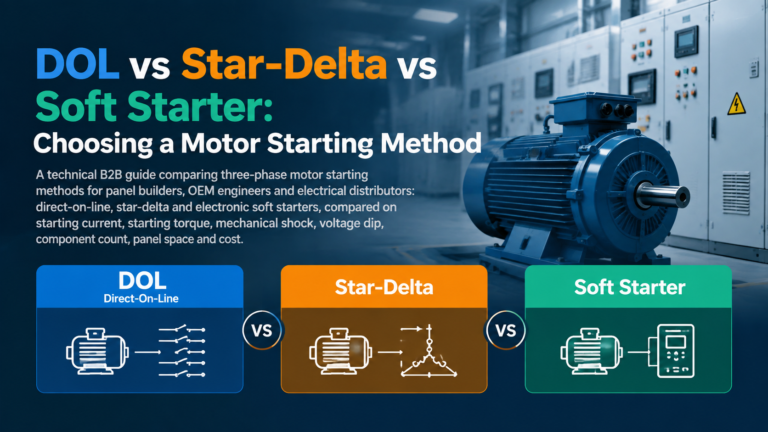
<p>Direct-on-line, star-delta and soft starters compared on starting current, torque, mechanical stress and cost - with the four questions that decide it.</p>
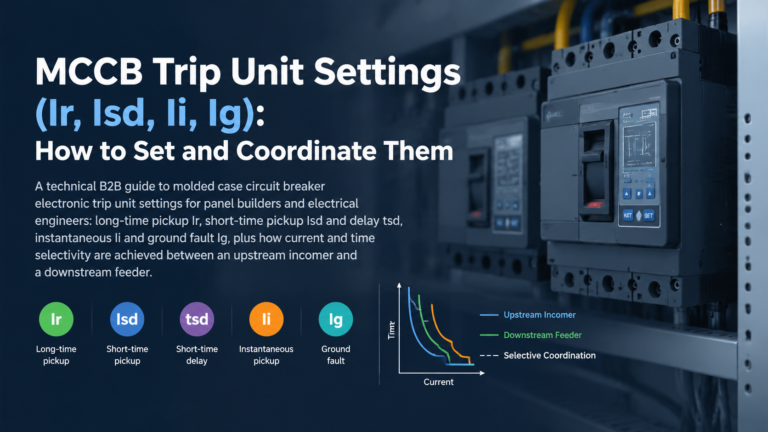
<p>What Ir, Isd, Ii and Ig mean, how to set them against the circuit rather than the frame, and how Isd and tsd deliver selective coordination between two MCCBs.</p>