DOL vs Star-Delta vs Soft Starter: Choosing a Motor Starting Method
Yayın tarihi: Yazar: Rachel
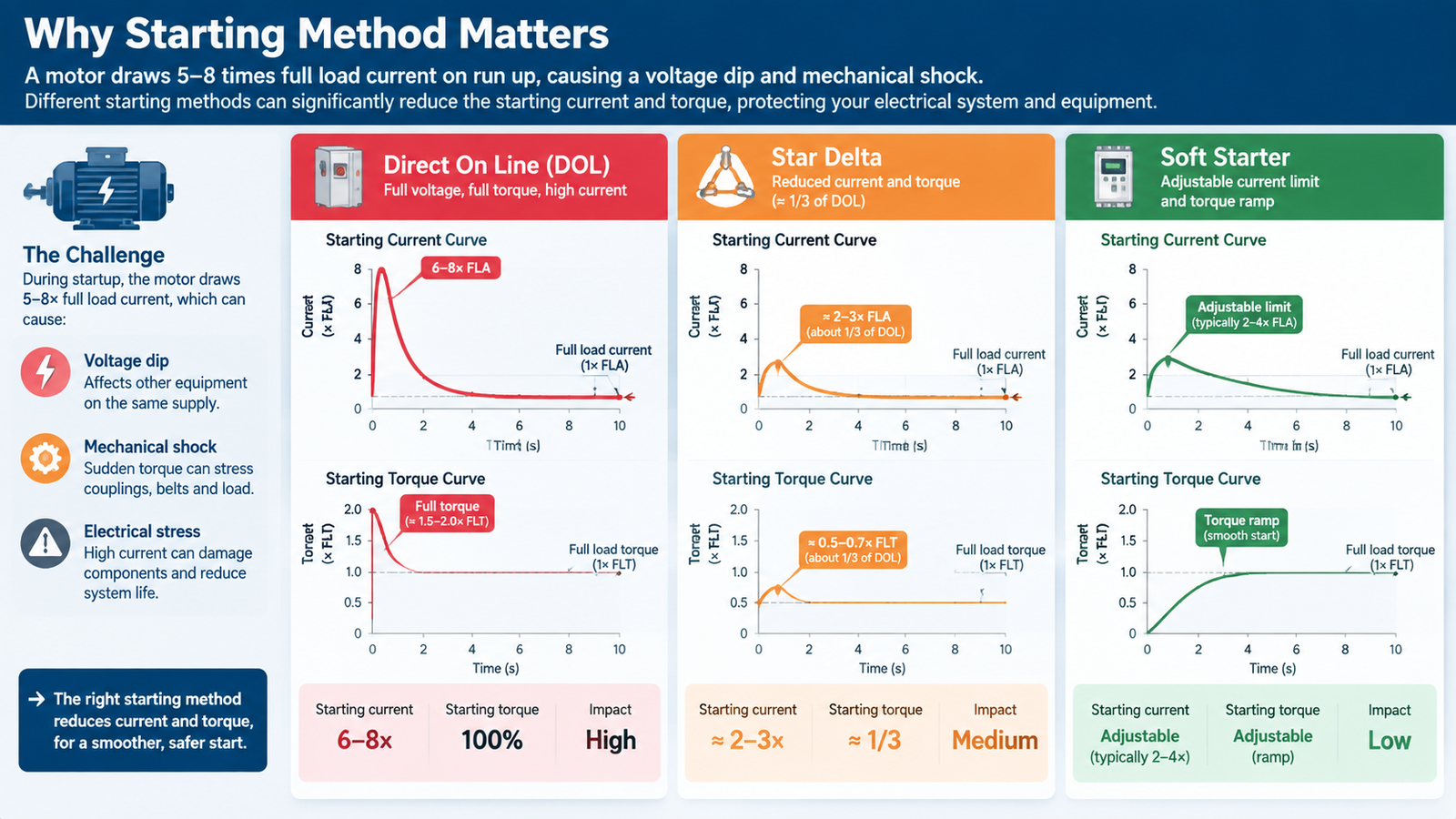
A three-phase motor draws five to eight times its full-load current while it runs up to speed. That inrush is not a fault — but it is the reason starting method is a design decision rather than a default. Start a large motor directly on line and you get maximum torque, maximum current and maximum mechanical shock. Start it softly and you protect the supply, the coupling and the driven machine, at the cost of money and panel space.
This guide compares the three methods you will actually be choosing between — direct-on-line, star-delta, and electronic soft starters — on the criteria that decide it: torque, current, mechanical stress, cost, and what each one demands of the switchgear.
Why Starting Method Matters at All
Three things happen when a motor starts across the line:
Current surge. Typically 5–8 × full-load current, held for the duration of the run-up.
Voltage dip. That current flowing through supply impedance pulls the local voltage down, affecting everything else on the same bus.
Mechanical shock. Full voltage produces full starting torque instantly, which is transmitted through couplings, belts, gearboxes and the driven load.
A small motor on a stiff supply makes all three invisible. A 90 kW pump on a weak supply or a long feeder makes all three the dominant design constraint.
Direct-On-Line (DOL)
DOL connects the motor straight to the supply at full voltage. It is the simplest, cheapest and most robust starting method there is: one contactor, one overload relay, one circuit breaker.
What you get
Full starting torque — typically 1.5–2.5 × full-load torque.
Highest starting current — typically 6–8 × full-load current.
Shortest run-up time — the motor reaches speed quickly.
Lowest cost and smallest panel footprint.
When it is the right answer
DOL is correct whenever the supply can absorb the current surge and the load can absorb the torque. In practice that means smaller motors — in many installations up to roughly 5–7.5 kW as a matter of course, and larger where the supply is stiff and the load tolerates a hard start. Pumps, fans and compressors started unloaded or against a closed valve are frequently DOL at ratings well above that.
What it demands of the switchgear
The contactor must be sized for the starting duty, not just the running current — this is the AC-3 utilisation category question we cover in our AC kontaktör seçim kılavuzu. And the protective device must be selected so it does not trip on the inrush: a breaker with an instantaneous set too low will nuisance-trip every time the motor starts. Our LC1D 25–38 A ve LC1D 40–65 A contactors cover the bulk of DOL applications.
Star-Delta (Wye-Delta)
Star-delta starting reduces the voltage across each winding during run-up. The motor is initially connected in star, which puts each winding across the phase-to-neutral voltage rather than the phase-to-phase voltage — a factor of 1/√3, or about 58%.
Both starting current and starting torque scale roughly with the square of the applied voltage. At 58% voltage that means about one-third of both: starting current drops to roughly 2–3 × full-load current, and starting torque drops to roughly one-third of the DOL value.
What you get
Reduced starting current — around 1/3 of DOL.
Reduced starting torque — also around 1/3 of DOL. This is the catch.
No electronic components — an electromechanical solution, three contactors and a timer.
An open transition — there is a brief break in supply as the motor switches from star to delta.
When it is the right answer
Star-delta suits motors that start light — fans, centrifuges, unloaded compressors, pumps started against a closed valve. It is a poor choice for anything that needs meaningful torque to break away, because one-third torque may simply not move the load.
What it demands
Three contactors instead of one, interlocked mechanically and electrically, plus a timer. The motor must have all six winding terminals brought out and must be designed for delta running on the supply voltage. There is also the transition spike: when the motor is momentarily disconnected and reconnected, it can draw a current transient as it resynchronises, which partly offsets the reduction you were trying to achieve.
Soft Starter
A soft starter uses anti-parallel thyristors to ramp the voltage up from a set initial value to full voltage over a controlled time. Torque and current follow the voltage, so both can be shaped to suit the load.
What you get
Adjustable current limit — typically settable from about 2 × to 5 × full-load current.
Adjustable torque — enough to break the load away without the mechanical shock of DOL.
Controlled ramp-down as well as ramp-up, which matters for pumps where you want to avoid water hammer.
Smooth, stepless transition — no open transition spike.
Protection and monitoring — most units include overload, phase loss and thermal protection, plus status outputs.
What it costs you
Higher capital cost than either alternative.
Panel space and heat — thyristors dissipate heat and usually need ventilation.
Harmonics during starting — generally acceptable, but worth noting on sensitive supplies.
Still not speed control — if you need to vary speed during operation, you need a variable frequency drive, not a soft starter.
Side-by-Side Comparison
Criterion
Direct-on-line
Star-delta
Soft starter
Starting current
6–8 × FLC
2–3 × FLC
Adjustable, typically 2–5 × FLC
Starting torque
Full (1.5–2.5 × FLT)
About 1/3 of DOL
Adjustable, set above breakaway torque
Mechanical shock
Highest
Moderate, plus transition spike
Lowest of the three
Voltage dip on supply
Largest
Reduced
Controlled and limited
Main components
1 contactor + overload
3 contactors + timer
Electronic controller + bypass contactor
Motor cable requirements
3 cores
6 cores
3 cores
Capital cost
Lowest
Low–moderate
Highest of the three
Panel space
Smallest
Moderate
Larger, with heat to manage
Speed control during running
No
No
No — that requires a VFD
Best suited to
Small motors, stiff supply, tolerant load
Larger motors starting light
Where current limit, smooth ramp or soft stop is needed
How to Decide in Practice
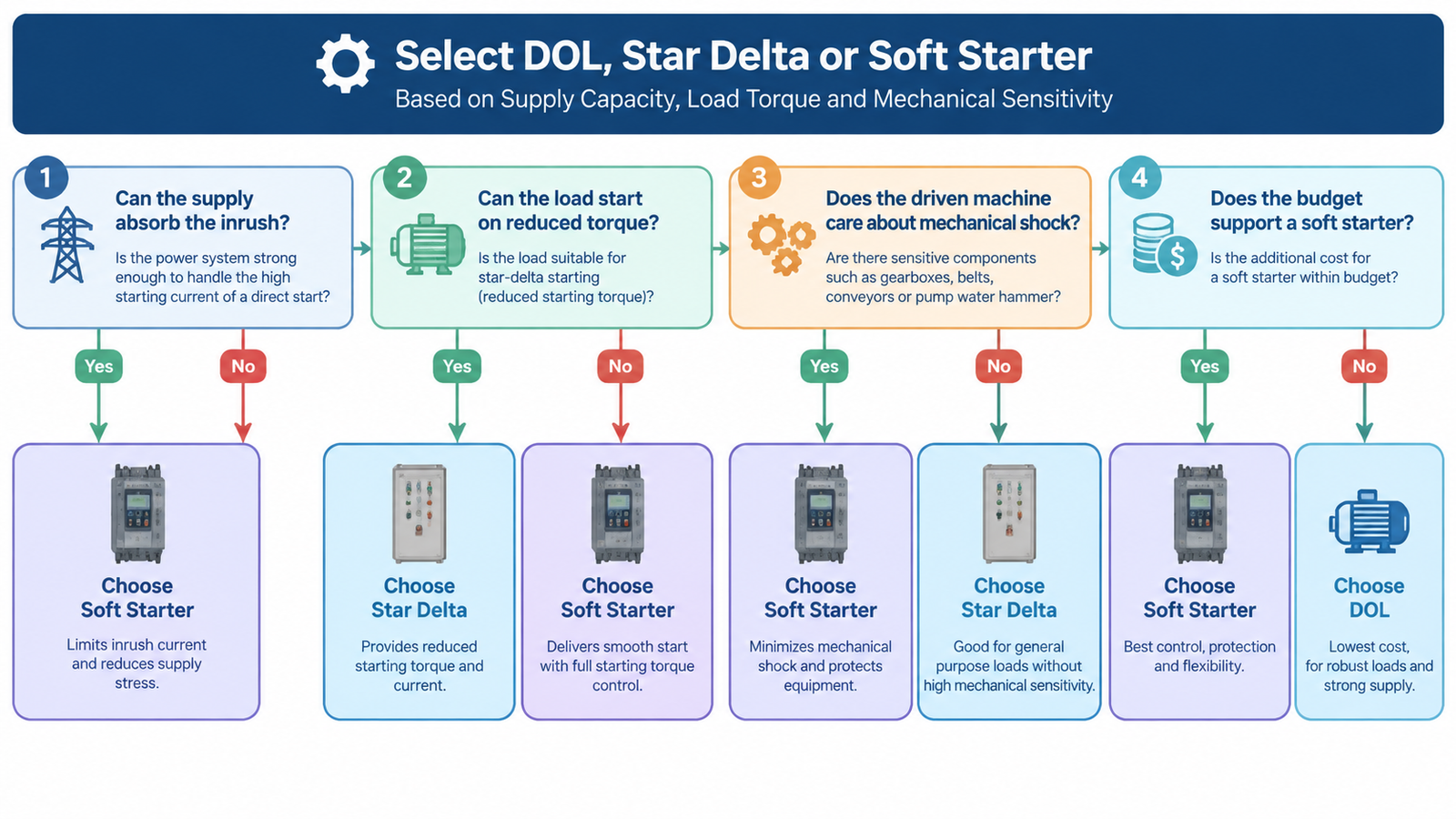
Work through four questions in order:
Can the supply absorb the inrush? Check the voltage dip against what the rest of the installation tolerates. If a DOL start dims the lights or upsets other equipment, DOL is off the table regardless of everything else.
Can the load start on reduced torque? This is the star-delta gate. If the load needs full torque to break away, one-third torque will not move it and star-delta is eliminated.
Does the driven machine care about shock? Gearboxes, belt drives, conveyors and pumps with long pipe runs all benefit from a soft start. Water hammer on pump stop is a soft-starter argument on its own.
Does the budget support it? If DOL passes questions 1 and 2 and the load tolerates the shock, DOL is still the right answer. Simplicity is a genuine engineering virtue, not just a cost saving.
What It Means for Protection and Switchgear
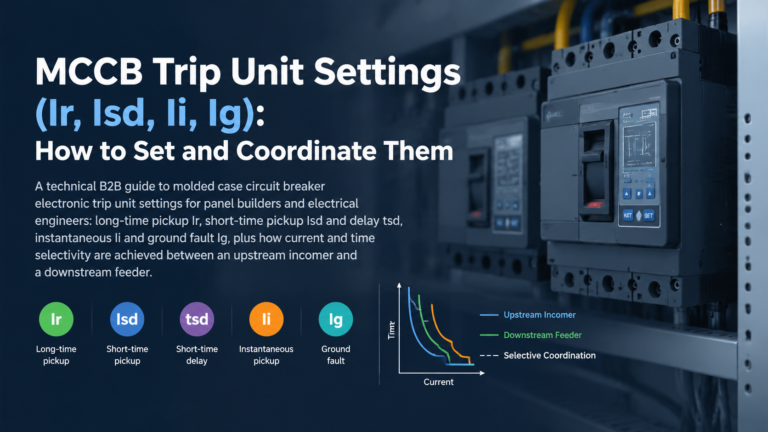
Whichever method you choose, the protective device has to be set around the starting current, not the running current. An MCCB with an instantaneous pickup set too low will trip on every start; set too high and it stops protecting the cable. That is a trip unit setting question, and it is covered in detail in our guide to MCCB trip unit settings (Ir, Isd, Ii, Ig).
Contactors also need selecting for the duty. Frequent starting and stopping — and star-delta switching in particular — is a harder duty than simply holding a motor in circuit. If you are commissioning or troubleshooting a starter, our AC kontaktör arıza giderme kılavuzu covers the failure modes that show up most often. For larger motors, the LC1D 80–95 A ve LC1D 115–150 A ranges cover the upper end.
Common Mistakes
Choosing star-delta on a high-breakaway-torque load. One-third torque will not move it, and the motor sits in star until the timer gives up or the overload trips.
Setting the star-delta timer by guesswork. Switch too early and you get a current spike; too late and the motor labours in star.
Ignoring the open transition. The momentary disconnection produces its own transient, and on some supplies that transient is the problem you were trying to solve.
Expecting a soft starter to control speed. It controls the start and stop ramps. Running speed control requires a VFD.
Sizing the breaker on running current. Starting current is what determines whether it will nuisance-trip.
Forgetting ventilation. Soft starters dissipate heat; a sealed enclosure with no allowance for it is a reliability problem waiting to happen.
Sık Sorulan Sorular
At what motor size should I stop using DOL?
There is no universal kW threshold — the limit is set by the supply’s ability to absorb the inrush and the load’s tolerance of full torque. As a rough guide many installations use DOL up to 5–7.5 kW as standard practice, and larger where the supply is stiff and the load starts light.
Why does star-delta reduce torque so much?
Both torque and current scale approximately with the square of the applied voltage. In star each winding sees 1/√3 of the line voltage, so both fall to roughly one-third of the DOL value. That is exactly why star-delta only works on loads that start light.
Can I use a soft starter where I currently use star-delta?
Usually yes, and it removes the six-core cable requirement and the open transition. The trade-offs are higher capital cost, panel heat, and the need to confirm the load does not need speed control during running.
Do I need a bypass contactor with a soft starter?
Most installations use one. Once the motor is up to speed the contactor bypasses the thyristors, eliminating their heat dissipation during normal running and extending their life.
Does the starting method change my breaker selection?
Yes. The breaker’s instantaneous and short-time settings must sit above the starting current to avoid nuisance tripping, while long-time protection still has to protect the cable. Lower starting current makes that balance easier to strike.
Choose on Torque First, Cost Second
The deciding question is almost never “which is cheapest” — it is “which one will actually start this load on this supply.” Answer the torque and inrush questions first, and the cost question usually resolves itself.
Building motor starters and need contactors and protection matched to the duty? Send us the motor ratings and starting method. Contact our engineering team and we will confirm the right contactor and MCCB combination.
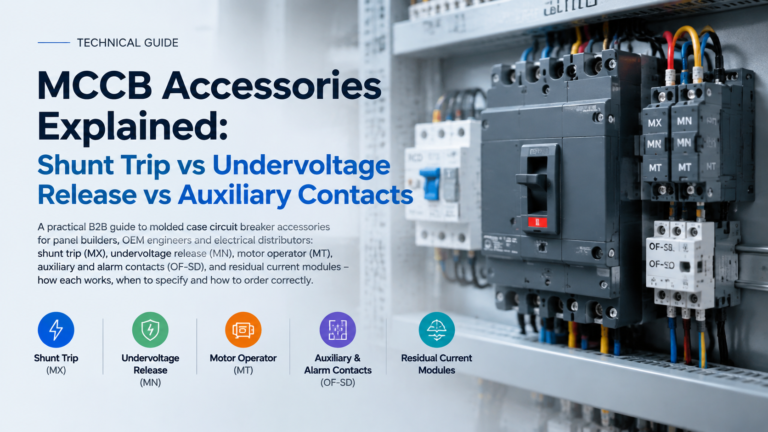
<p>Shunt trip, undervoltage release, auxiliary contacts and motor operators compared - what each MCCB accessory actually does, when to specify it, and the checklist to order the right one first time.</p>
<p>What Ir, Isd, Ii and Ig mean, how to set them against the circuit rather than the frame, and how Isd and tsd deliver selective coordination between two MCCBs.</p>
<p>A two-step transformer method for estimating fault level, how cable impedance and motor load change it, and how to turn the result into an Icu/Ics rating.</p>