


AC Contactor Troubleshooting: 7 Common Problems & Fixes
AC contactor troubleshooting guide covering chattering, burnt coils, welded contacts and overheating, with multimeter testing steps and prevention tips for longer contactor life.
Read More English
Current flows out on the live conductor and comes back on the neutral. When those two values stop matching, something is wrong. A residual current device (RCD) then has about 40 milliseconds to decide what to do about it.
That decision saves lives, and it is worth understanding properly. Whether you call it an RCD, RCCB, RCBO, or GFCI, the physics is identical: the device watches for current escaping the circuit and opens the contacts before that leakage can harm a person or start a fire. This guide covers how the measurement works, which sensitivity to select, and how a bolt-on Vigi module turns a molded case circuit breaker into a complete earth-leakage breaker.
An RCD compares the current leaving the supply with the current returning through the neutral. The phase conductors pass through a ring-shaped current transformer, and so does the neutral. Under healthy conditions the vector sum of those currents is zero, the core sees no flux, and the trip mechanism stays silent.
Introduce a fault and everything changes. A cable with damaged insulation touches a metal enclosure. Water seeps into a junction box. A person grabs a live part. Some of the current now flows to earth instead of returning through the neutral, the sum is no longer zero, and the secondary winding of the transformer picks up the imbalance and drives the trip.
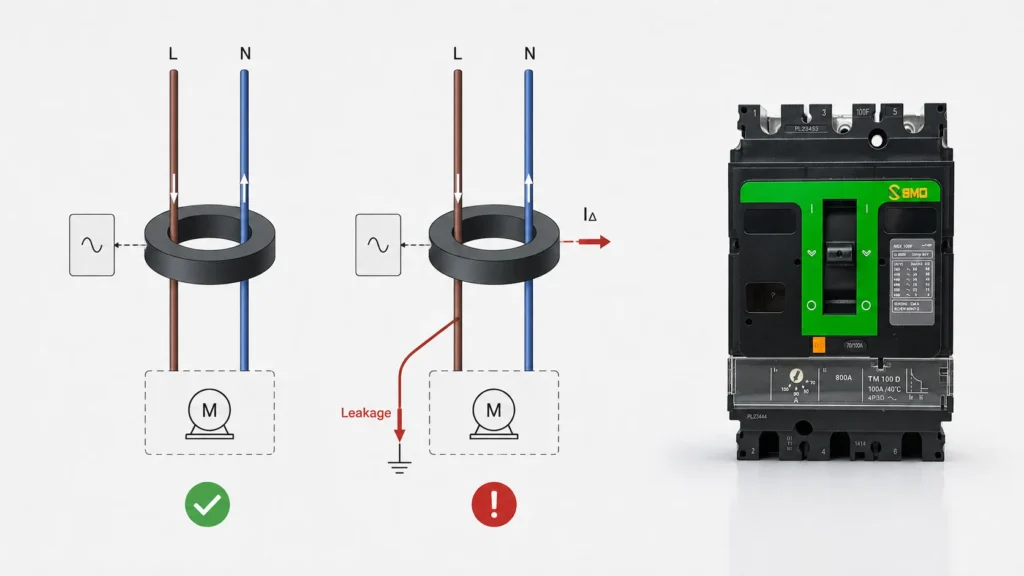
That imbalance is the residual current, and the level at which the device acts is marked IΔn on the label. The device only cares about what does not come back.
RCD is the family name, not a single product. An RCCB provides residual current protection and nothing else: no overload protection, no short-circuit protection. An RCBO squeezes both functions into one unit, which is why it is the default choice for socket circuits in residential boards.
Industrial panels solve the same problem differently. Instead of an all-in-one RCBO, you take a breaker that already handles overload and short circuit, then bolt a residual current module underneath it. The SxC60 miniature circuit breaker covers the 1 A to 63 A range for distribution boards, and the add-on module supplies the leakage detection the MCB does not have.
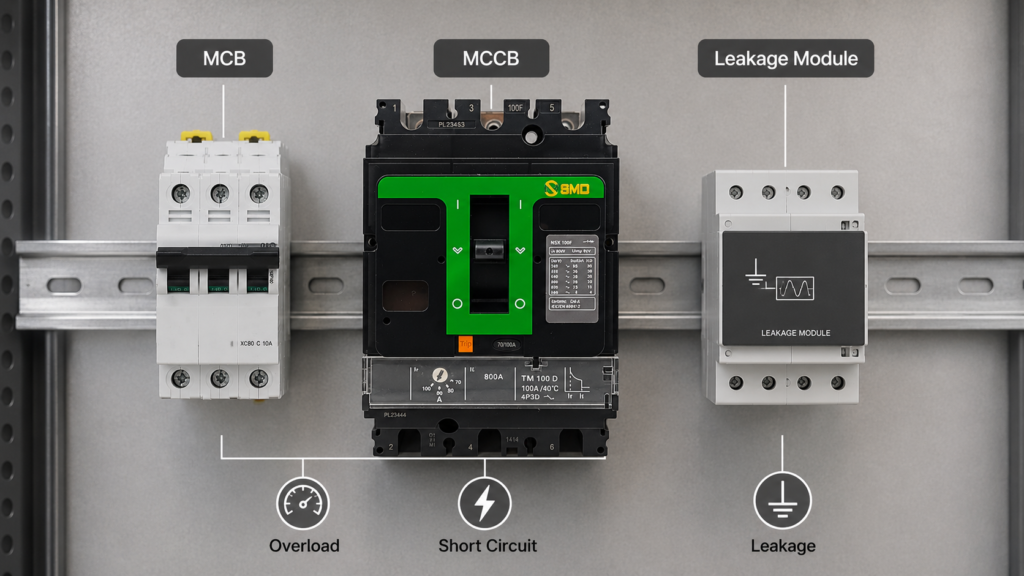
The Vigi module mounts on the underside of a compatible molded case circuit breaker and gives that breaker a residual current function it does not have out of the box. Fit it to a SNSX 100A–250A molded case circuit breaker and a feeder gains 30 mA personnel protection. Fit it to the SNSX 400A–630A frame and you can set 300 mA or 500 mA with an adjustable delay for fire and equipment protection.
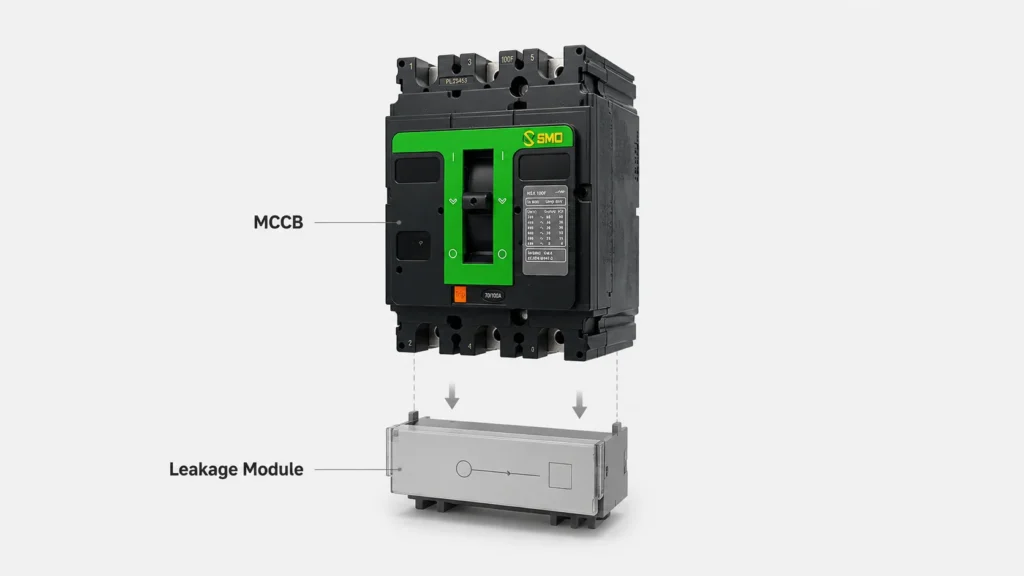
WZSMO’s SNSX Vigi module spans 100 A to 630 A frames and offers sensitivities of 30, 100, 300, and 500 mA, with instantaneous or adjustable tripping delay. An isolated signal contact option (SDV) reports a leakage trip to a PLC or an alarm panel, so a fault never goes unnoticed. The module is tested to IEC 60947-2 Annex B, the annex written specifically for residual current protection integrated into circuit breakers, and carries CE marking for the European market.
One breaker, two layers of protection. The MCCB clears the big faults, and the Vigi module catches the ones the breaker cannot see. It also keeps panel space small: a 250 A incomer with leakage protection fits in one position instead of two enclosures.
Sensitivity selection is where most specifying mistakes happen. The table below shows the standard IΔn steps and what each one is built for.
| Rated sensitivity IΔn | Primary job | Typical locations |
|---|---|---|
| 10 mA | Very high-sensitivity shock protection | Hospital beds, laboratories, wet rooms |
| 30 mA | Personnel protection against direct contact | Socket circuits, portable tools, construction sites |
| 100 mA | Shock plus fire protection | Commercial distribution, main incomers |
| 300 mA | Fire and equipment protection | Industrial feeders, MCCB + Vigi combinations |
| 300 / 500 mA, delayed | Selectivity with downstream 30 mA devices | Main switchboards |
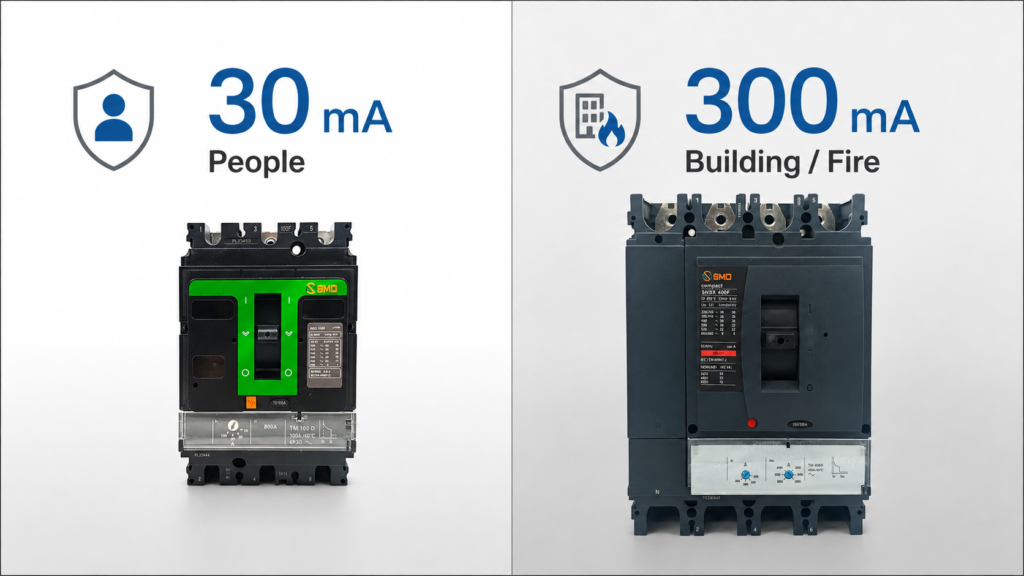
The 30 mA value is not a convention. It is physiology. Ventricular fibrillation becomes a real risk once current through the body approaches 30 to 50 mA, so the IEC limit for direct personal protection sits at 30 mA, and a compliant device must clear 250 mA (5 × IΔn) in under 40 ms. That is fast enough to keep most direct-contact events below the dangerous energy threshold.
300 mA devices do not protect people from direct contact. They protect buildings. A cable leaking 200 mA to earth through damaged insulation will eventually generate enough heat to start a fire, and a 300 mA unit catches that without tripping on the normal leakage that industrial equipment produces. This is why a SNSX 400A–630A molded case circuit breaker with a 300 mA Vigi module is a common incoming arrangement for motor feeders.
For selectivity, the most sensitive device belongs closest to the load. The 30 mA unit in the final circuit trips first, the 300 mA delayed unit at the board holds its position, and only the faulty circuit goes dark. Everyone else keeps running.

Four mistakes cause most of the field problems we see, and all of them are avoidable.
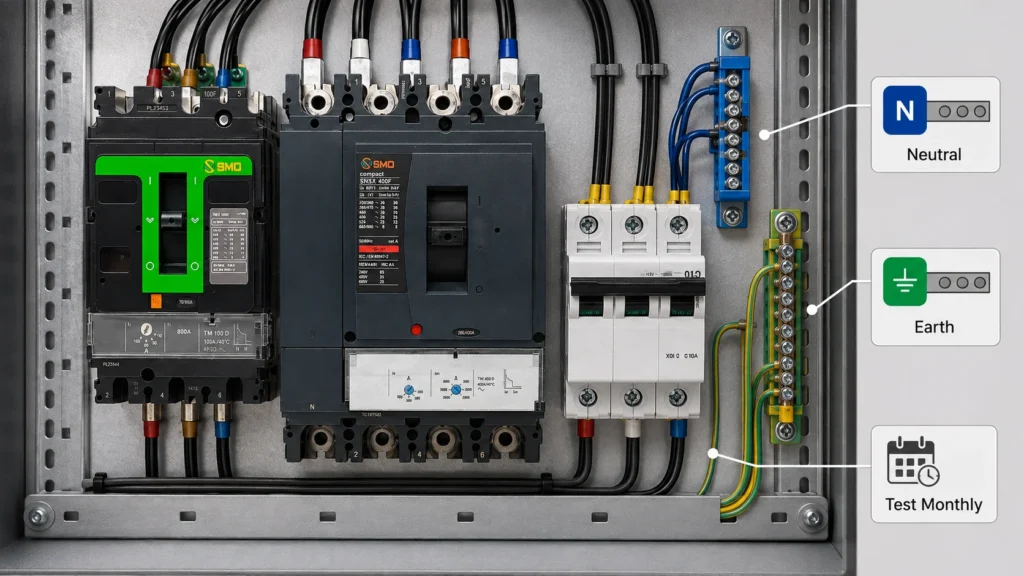
First, the protective earth conductor must never pass through the measuring transformer, and the neutral must not be bridged between RCD-protected and unprotected circuits. Mixing neutrals is the classic panel error. It reads as a permanent residual current, and the device trips for no apparent reason.
Second, pick the right type for the load. A type AC device only sees sinusoidal alternating leakage, but modern electronics produce pulsating DC that can blind it. EV chargers, variable frequency drives, and appliance-heavy circuits call for type A. The marking on the device tells you which one you have.
Third, budget for natural leakage. Every metre of cable, every surge arrester, and every filter capacitor leaks a little current, and when total background leakage approaches one third of IΔn, random trips start. On a 30 mA circuit, that means keeping the standing leakage under 10 mA.
Fourth, press the test button. Once a month, on every device, without exception. The button injects a simulated residual current and proves the mechanism still operates. It costs five seconds and finds the devices that died quietly.
RCD is the family name for residual current devices. An RCCB provides only residual current protection, while an RCBO combines residual current protection with overload and short-circuit protection in one housing. In industrial panels, the same combination is achieved by pairing a breaker with a Vigi module.
Not always, but it gets close. A 30 mA device clears a 250 mA fault in under 40 ms, which keeps most direct-contact events below the dangerous energy threshold. The residual current must actually pass through the device’s transformer, which means the earth path must be intact and the neutral must not be bridged downstream.
Random tripping usually means leakage, not a fault. Appliance interference filters, moisture in outdoor fittings, old cable insulation, and lightning-induced transients all push current to earth. Measure the background leakage with an insulation tester. If it sits near one third of IΔn, the device is doing its job and the installation is not.
No. It must match the frame it mounts on. The SNSX Vigi module fits SNSX and SCVS frames from 100 A to 250 A, and SNSX, SCVS, and SEZC frames from 400 A to 630 A. Check the compatible frame list before ordering, because a module from the wrong frame will not line up mechanically or electrically.
For direct shock protection, 30 mA belongs on socket circuits, portable tools, and wet locations. A 300 mA or 500 mA setting with adjustable delay is the usual choice for a three-phase feeder, where it guards against fire and insulation faults while tolerating normal leakage. Both levels are available on the same Vigi module.
Three numbers carry the whole argument: 30 mA for people, 300 mA for buildings, and 40 ms for both. Match the sensitivity to the circuit, keep the earth conductor out of the measuring loop, and test the button monthly. Residual current protection then works quietly for decades.
MCCBs clear the overloads and short circuits. Vigi modules catch the leakage a breaker cannot see, which is why the pairing belongs in every panel you design. If you are specifying an incoming feeder or a motor circuit and want a second opinion on the leakage protection, WZSMO’s engineers answer sizing questions daily. Contact WZSMO with your circuit details and we will send you a quotation.