AC Contactor Supplier Guide: Coil Voltage and AC-3 Rating
Published: Author: Rachel
What an AC Contactor Supplier Should Specify Before Quoting
An AC contactor looks like a simple device until you order one from an overseas supplier. The catalogue entry shows a current rating and a coil voltage, and that is where most purchasing stops. By the time the shipment arrives, the difference between a usable part and an unusable one is usually sitting on the nameplate and was never stated in the quotation.
This guide covers what an AC contactor supplier should confirm with you before pricing, what the nameplate markings actually mean, which coil and control options affect the ordering, and what to check when the goods arrive. The emphasis is on specification rather than theory, because by the time you are comparing supplier quotations the technical decisions have already been made upstream.
The coil voltage is set at installation and is rarely visible from outside the housing. This is why it has to be stated on the order.
If you have not yet chosen a supplier, our MCCB sourcing checklist covers the verification steps that come before this stage.
Why Contactors Are Specified Differently from Breakers
A molded case circuit breaker is specified mainly by its protection parameters: rated current, breaking capacity, trip curve. A contactor is a switching device, so its specification is dominated by control parameters instead. The rated current tells you what the power circuit can carry. It does not tell you what voltage the coil needs or how the device will be driven.
Two contactors with an identical 40 A rating can behave completely differently in a panel if one has a 24 V DC coil and the other has a 230 V AC coil, or if one includes an auxiliary contact block and the other does not. Getting those fields right at quotation stage is the difference between a drop-in replacement and a return shipment.
Utilization Category Is the First Question to Ask
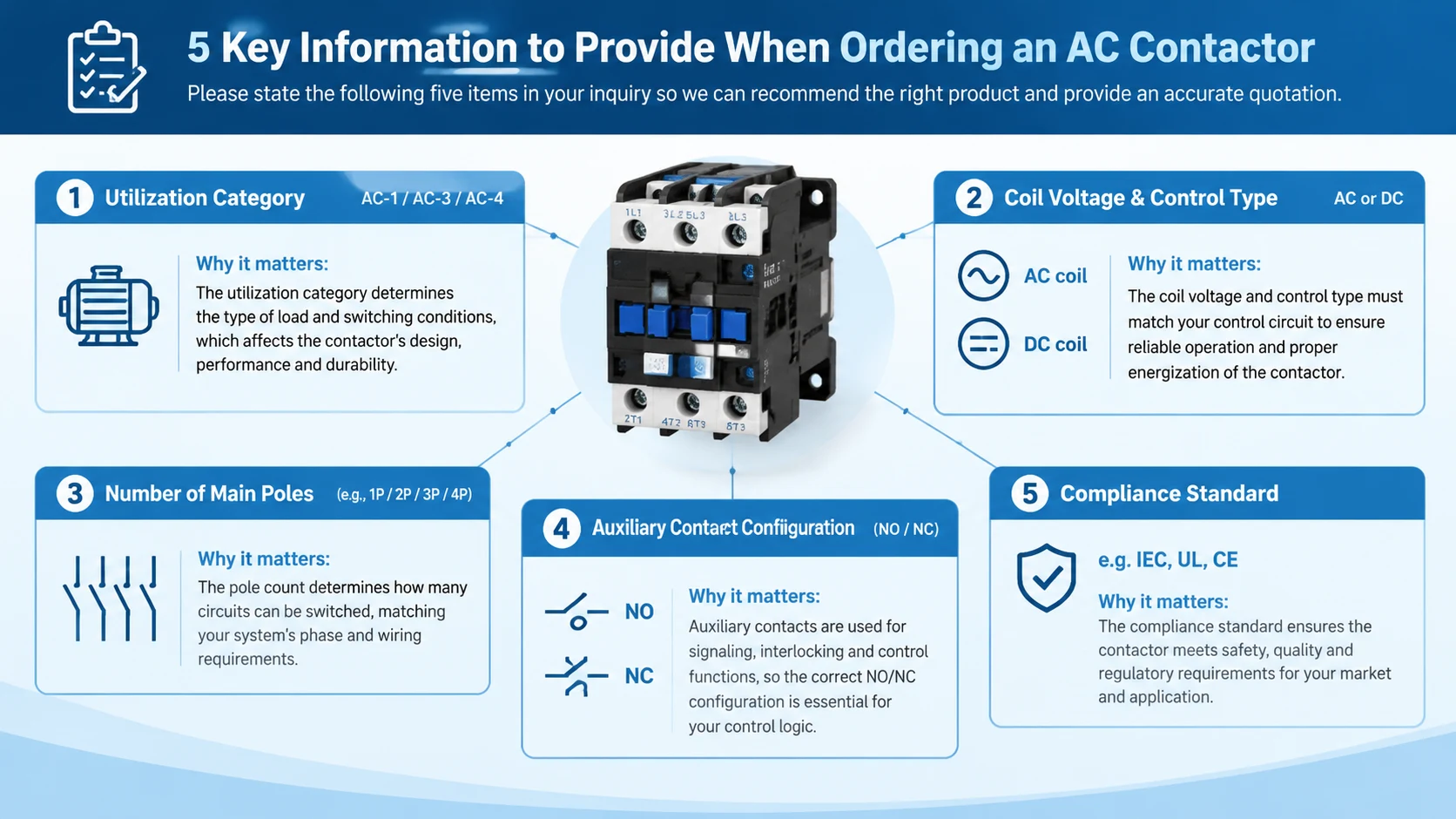
The utilization category, marked on the device as AC-3, AC-4 or AC-1, defines what kind of load the contactor is rated to switch. It is not a marketing label; it changes the rated current the contactor can safely interrupt.
AC-1 covers resistive loads or those with a very small switching burden. AC-4 covers switching of lightly inductive loads. AC-3 covers squirrel cage motor loads, and it is the category that matters for the overwhelming majority of motor control applications. Because the categories carry different rated currents for the same physical device, a contactor quoted without a category cannot be compared against one that has it.
Ask for the utilization category explicitly. If your application is a motor, AC-3 is almost certainly what you need, and a supplier who does not mention it has not confirmed that the device is rated for your load.
Five fields to state in the enquiry. Anything left open becomes an assumption the factory makes on your behalf.
Coil Voltage and Control Type
The coil voltage is the single most common cause of a contactor arriving unusable, because it is specified for the control circuit rather than the power circuit. A contactor rated for 400 V three-phase power still needs a separate low-voltage supply to energise its coil.
Control type refers to whether the coil is operated by AC or DC. This is not an interchangeable detail. A DC-controlled contactor with a DC coil holds its contacts in position with less hum and less power consumption, which is why control panel designers often specify DC control even where the panel supply is AC. The AC contactor basics article covers the coil and armature arrangement in more detail.
Confirm the standard coil voltage for your market
Common control voltages include 24 V DC, 110 V AC, 220 V AC and 230 V AC. These are not interchangeable, and the voltage is usually printed on the coil itself rather than being visible from outside the housing. State the required voltage in the enquiry rather than assuming a default.
Ask whether other voltages are available
Most manufacturers offer a range of coil voltages for the same frame. If your standard voltage is not the default, confirm availability before ordering, because a non-standard coil may carry a different lead time than the stocked version.
Pole Configuration and Auxiliary Contacts
The number of main poles determines how the power circuit is switched. Three-pole devices are standard for three-phase motor control. Configurations with additional poles or with a specific pole count should be confirmed at the specification stage, because changing pole count changes the physical width of the device and therefore the panel layout.
Auxiliary contacts serve a different purpose: they report the contactor state back to the control circuit. A normally open auxiliary contact closes when the contactor energises, and a normally closed contact does the opposite. These are used for interlock, signal feedback and sequence control.
Confirm two things about auxiliary contacts: how many are fitted, and whether they are supplied with the contactor or added separately. A contactor with auxiliary contacts bolted on looks identical at a glance to one without, and the ordering error is only discovered when the control circuit is wired.
A contactor specified without coil voltage, utilization category and auxiliary contact details is not yet a specification. It is a product family reference.
What the Nameplate Confirms
Before anything is shipped, ask for a photograph of the nameplate at the exact rating and configuration being ordered. The nameplate should confirm the rated operational current, rated insulation voltage, coil voltage, utilization category, terminal markings and the compliance standard.
Two details are worth checking explicitly. First, the rated operational voltage should match the installation, not just the family. Second, the compliance marking should match the certificate that accompanies the shipment. These two must agree. A device marked to one standard cannot be covered by a certificate issued for another, and a mismatch at customs is a delay rather than a warning.
Terminal Markings and Connection Method
Terminal designations such as 1L1, 3L2 and 5L3 on the incoming side and 2T1, 4T2 and 6T3 on the outgoing side follow a convention that lets you wire the contactor consistently. Our AC contactor troubleshooting guide covers what these markings mean when a contactor is not behaving as expected.
Connection type matters for installation. Screw terminals are universal and need no special tooling. Some configurations offer push-in or solder variants that reduce assembly time in volume production but require different tooling and different operator training. If your customer assembles panels themselves, screw terminals are usually the safer choice. If they run high-volume automated assembly, ask whether a push-in variant is available.
Compliance Standards for Contactors
Contactors for industrial use are covered by IEC 60947-4-1, which is the relevant part of the IEC 60947 series for switching devices below a certain power threshold. Domestic Chinese practice follows the corresponding GB series. Export buyers should confirm which of these the documentation covers, and whether the destination market requires anything further.
Some markets have additional expectations for components installed in industrial machinery. These are usually handled at the panel level rather than the component level, but a supplier who cannot tell you which standard their documentation follows has not verified it.
How SMO Configures the SMO-K Contactor Range
Stating our own configuration plainly lets you check it against the points above.
Our SMO-K series contactors use DC electromagnetic control, with three poles as standard and a rated current range from 9 A to 150 A across the available frame sizes. Rated insulation voltage is 690 V AC, and rated operational voltage covers 220 V, 380 V and 690 V at 50/60 Hz. The standard coil voltage is DC 24 V, and other DC coil voltages are available on request.
The utilization category is AC-3, rated ultimate breaking capacity at 380 V AC is six to eight times rated current, and mechanical durability is ten million cycles or more. Connection type is screw terminal. Auxiliary contacts in normally open and normally closed combinations can be added to suit the control circuit, and the compliance standard is IEC 60947-4-1.
Because the coil voltage and auxiliary contact configuration are the two fields most often left open, specify both when requesting a quotation. Custom labeling and packaging are covered on the ODM/OEM page, and enquiries can go to our contact page. If you also need circuit breakers for the same panel, the molded case circuit breaker range uses the same enquiry format.
Questions Worth Asking an AC Contactor Supplier
What coil voltage and control type does this quotation assume?
If the supplier answers without asking which voltage you need, assume they defaulted to whatever is in stock.
Which utilization category is the quoted rating valid for?
The rated current changes between categories. A supplier who quotes a current rating without naming the category has quoted you a number that may not apply to your load.
Are auxiliary contacts included, and how many?
Ask for the exact number and combination of normally open and normally closed contacts, and whether they are fitted at the factory or supplied as separate items.
Can you send a nameplate photograph at the exact configuration?
A supplier with stock on hand can usually produce this the same day. If it takes effort, that is itself information.
What standard does the documentation cover?
Ask for the certificate reference and confirm it covers the specific frame and configuration, not just the product family.
What is the lead time for a non-standard coil voltage?
Standard voltages are usually held in stock. Non-standard configurations often carry additional lead time, and this is worth knowing before you commit to a delivery date.
Why This Matters Before the Goods Arrive
An AC contactor is a low-cost component inside a panel that may hold hundreds of them. If the coil voltage is wrong, the entire batch is unusable and the fix is not a component swap; it is finding every affected panel in your market. That cost is far larger than the price difference you saved by accepting the cheapest quotation.
The specification fields covered here are quick to confirm and expensive to get wrong. Send them with the enquiry, confirm them against the nameplate before shipment, and check them again on arrival.
What MCCB Price Actually Reflects Two quotations for molded case circuit breakers can differ by a factor of ten and both be legitimate. The reason is that an MCCB price is not one number. It is a set of variables multiplied together, and most buyers receive quotations that differ in more than one of those […]
What Makes an MCCB Supplier China Evaluation Different Ask a distributor why they buy molded case circuit breakers from China and you will usually get a price answer. Price matters, but it is the least complicated part of the decision. What actually determines whether an import program succeeds is whether the supplier you chose can […]
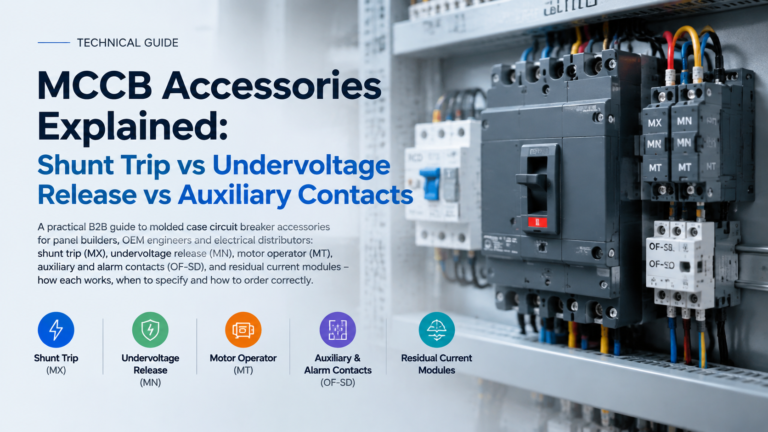
<p>Shunt trip, undervoltage release, auxiliary contacts and motor operators compared - what each MCCB accessory actually does, when to specify it, and the checklist to order the right one first time.</p>