MCCB de 3 pólos vs. 4 pólos: Quando o neutro faz realmente a diferença
Publicado: Autor: Rachel
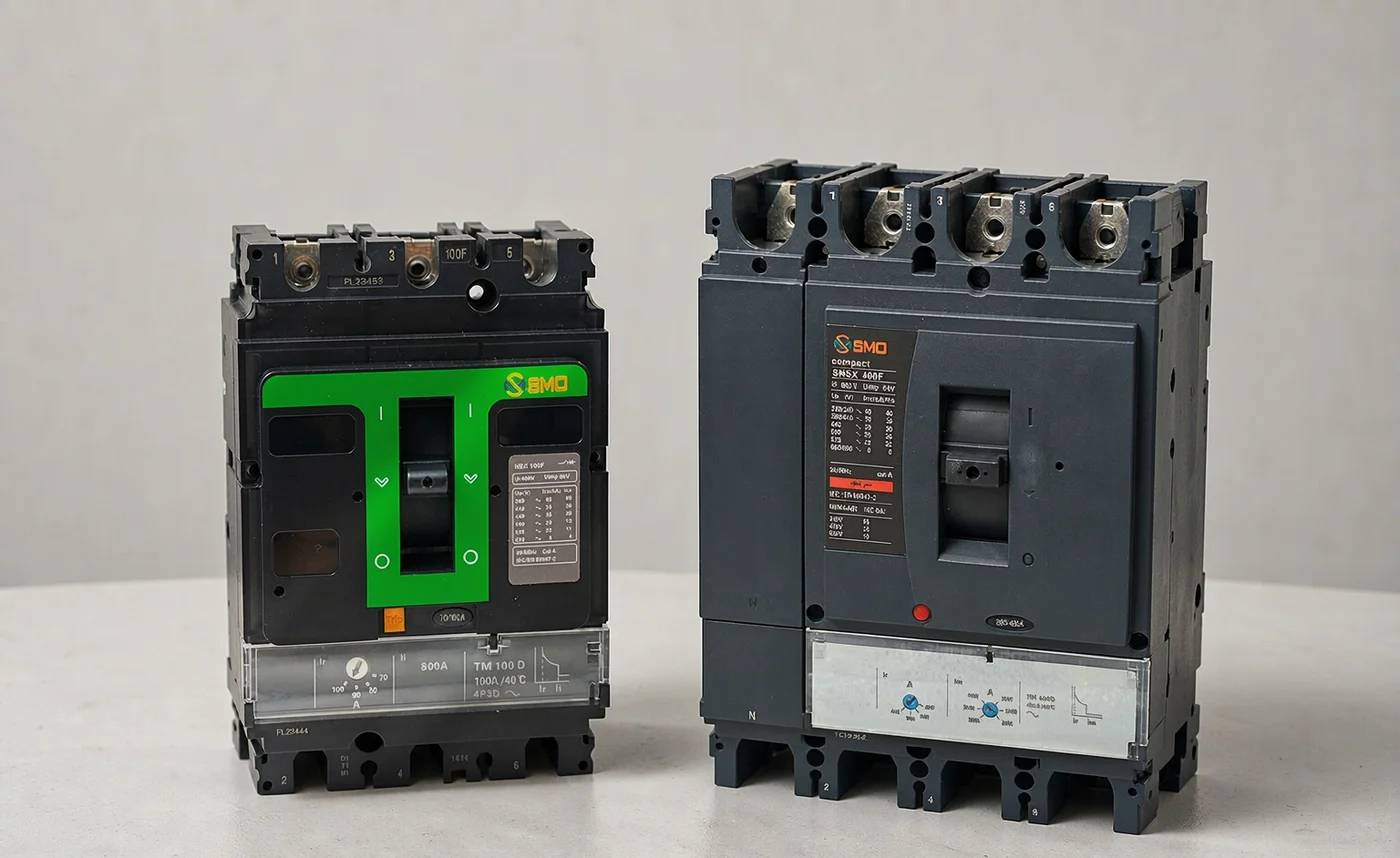
Two MCCBs sit side by side in a panel. Both are 250 A frames, both rated 36 kA at 415 V, both from the same catalogue page. One has three poles, one has four. The price gap is not the interesting part. The question worth answering is whether that fourth pole is doing any work, or whether it is adding 25% more width and one more set of contacts to maintain for nothing.
The MCCB 3 pole vs 4 pole decision gets treated as a question of conservatism, as though more poles were always the safer answer. It is not. Most specification mistakes on this subject come from treating “4 pole” as a safety upgrade. It is not. It is a specific answer to a specific question: does this neutral need to be opened, and does it need to be protected? Those are two separate questions, and they do not always get the same answer.
MCCB 3 Pole vs 4 Pole: What the Fourth Pole Actually Does
A four-pole MCCB carries the neutral conductor through a fourth pole that operates together with the three phase poles. That single mechanical fact bundles two functions which are often confused:
Switching. When the breaker is opened manually or trips, the neutral is disconnected along with the phases. This matters for isolation — a circuit where the neutral stays connected is not fully isolated, even with all three phases open.
Protection. Some four-pole devices also detect overcurrent in the neutral pole and trip on it. Others carry the neutral through a pole that only switches, with no sensing element at all.
That second distinction is where most of the trouble starts. A device described as “4 pole” in a quotation may be switching the neutral without protecting it. If the specification called for neutral overcurrent protection and nobody checked the trip element, the panel is built, tested, energised, and the protection that was designed for is simply not there.
A three-pole device does not touch the neutral at all. The neutral runs straight through the panel, typically on a solid link or a neutral bar, and stays connected regardless of what the breaker does.
MCCB 3 Pole vs 4 Pole: When Four Poles Are Required
Four poles earn their place in a small number of clearly defined situations.
Isolation on TT systems
On a TT system the neutral is not bonded to earth at the installation. It can float at a potential above earth, particularly under fault conditions elsewhere on the network. Opening the phases alone leaves the neutral live relative to earth, which makes downstream work unsafe. A four-pole device that opens the neutral gives genuine isolation.
Neutral overcurrent protection
In a balanced three-phase load, the fundamental currents cancel in the neutral and the neutral carries little or nothing. Switch-mode supplies, LED drivers, office equipment and variable speed drives change that. Their third harmonic currents do not cancel in the neutral — they add. On a badly behaved load the neutral current can exceed the phase current, and a neutral with no protection is then the weakest conductor in the circuit.
Where the supply authority or the client specifies it
Some utilities and some industrial clients simply require four-pole switching at the incoming device as a matter of local practice. That is a valid reason, and it is worth asking early, because it changes the panel width and the busbar arrangement.
When Three Poles Is the Correct Choice
Three poles is not the budget option. In several configurations it is the only compliant one, and understanding why is the other half of the MCCB 3 pole vs 4 pole question.
TN-C systems
In a TN-C system the neutral and protective functions share a single PEN conductor. That conductor must not be opened by any switching device, because doing so would leave equipment downstream with no protective earth path while still connected to live phases. A four-pole breaker installed at such a point is a code violation and a genuine hazard, not a conservative choice.
TN-S systems with a sound neutral
Where the neutral is a separate, solidly bonded conductor and the load is reasonably balanced, three poles is sufficient. The neutral stays connected, which is normal and expected in this arrangement, and the cost and space saved are real.
Panel economics
A four-pole 250 A MCCB is roughly a quarter wider than its three-pole equivalent, and the terminals, busbar stubs and cable lugs multiply with it. Across a row of outgoing devices in a distribution board, that difference decides whether the enclosure is 600 mm wide or 800 mm. It also adds a fourth set of contacts and a fourth set of terminations — more points to torque correctly and more points to heat up if they are not.
Neutral Protection: The Four Settings You Will See
Once you have decided the neutral is going through the breaker, the next question is what the neutral pole is set to do. Four arrangements appear in manufacturers’ catalogues, and they are not interchangeable.
Neutral setting
What it does
Where it is appropriate
Switched, unprotected
The neutral pole opens with the phases but has no overcurrent sensing
Isolation is the only goal; neutral current is known to stay well below phase current
50% protection
Neutral trips at half the phase setting
Balanced three-phase loads with no significant harmonic content
100% protection
Neutral trips at the same threshold as the phases
Loads with third harmonic content, where neutral current can approach or exceed phase current
Adjustable
Setting selectable on site, often between 50% and 100%
The final load mix is not known at specification stage
The 50% setting is common as a factory default, and it is the one that most often ends up mismatched to the load. It assumes the neutral will never carry more than half of what a phase carries. On a lighting circuit full of electronic drivers, or a panel feeding several variable speed drives, that assumption is wrong, and the neutral pole will either trip unnecessarily or — if it is the unprotected type — not trip at all when it should.
There is a second number to check on any four-pole device: the rated current of the neutral pole itself. Some devices carry a full-rated neutral pole; others carry a reduced one. If the neutral pole is rated below the phase poles and the load is harmonic-rich, the device is undersized for the duty even though the frame label looks correct.
System Earthing Decides Most of It
Work back from the earthing arrangement and most of the MCCB 3 pole vs 4 pole ambiguity disappears.
Earthing system
Typical pole choice
Reason
TN-C
3 pole
PEN conductor must not be opened by any device
TN-S
3 pole or 4 pole
Depends on whether isolation of the neutral is required; protection depends on harmonic assessment
TN-C-S
3 pole in the PEN section, then as TN-S
The rule follows the conductor type at that point in the installation
TT
4 pole, usually
The neutral is not earthed at the installation, so isolation requires opening it
IT
4 pole, commonly
Depends on whether a neutral is distributed at all and how it is referenced
The TN-C-S row is the one that trips people up. The installation changes character at the point where the PEN conductor is split into separate neutral and protective conductors. Upstream of that point, the conductor is a PEN and cannot be switched. Downstream, it is a neutral and the normal TN-S rules apply. A single rule applied across the whole installation will be wrong on one side of the split.
Where the Mistakes Actually Happen
Four recurring errors account for most of the problems seen on site:
Assuming 4 pole means protected neutral. The specification says “4P MCCB”, the quotation says “4P MCCB”, and the delivered device switches the neutral without sensing it. Always state the neutral function, not just the pole count.
Fitting 4 pole on a TN-C section. Usually done by someone applying a blanket rule to the whole board. It opens the PEN and removes the earth path for everything downstream.
Leaving the neutral at 50%. Fine on a motor panel, wrong on anything with a high proportion of electronic load.
Coordinating phases but not neutrals. Two cascaded four-pole devices where the upstream neutral trip is set lower than the downstream one will lose selectivity on neutral faults, even though the phase coordination study looked correct.
The last one is the least visible. A coordination study that only looks at phase settings will pass, the panel will be built to it, and the problem only appears the first time a neutral fault occurs upstream of where it should have been cleared.
How to Specify It Without Ambiguity
A specification that leaves no room for interpretation covers six points:
State the earthing system for that part of the installation. This alone settles most of the argument.
State whether the neutral must be opened for isolation, and why.
State whether the neutral requires overcurrent protection, based on a harmonic assessment of the load.
If protection is required, state the neutral setting as a percentage of the phase setting, and state the neutral pole rating.
Check the enclosure width and busbar arrangement against the four-pole option before the layout is frozen.
Include the neutral in the selectivity study, not just the phases.
Written that way, the quotation can be checked line by line. Written as “4P MCCB, 250 A, 36 kA”, it can be met by a device that does almost none of what was intended.
The full SMO range, including three-pole and four-pole frames with switchable or protected neutrals, is listed on the disjuntor em caixa moldada page. Frame sizes, breaking capacities and trip options are set out in the MCCB product category, and the settings themselves — Ir, Isd, Ii and Ig — are covered in Regulações da unidade de disparo do MCCB. If the frame size is still open, how to choose the right MCCB works through current, breaking capacity and trip type in the order that matters.
Perguntas frequentes
Can a four-pole MCCB be used on a TN-C system?
No. In a TN-C system the neutral and protective functions share a single PEN conductor, and that conductor must not be opened by any switching or protective device. A four-pole breaker at that point would disconnect the protective path from everything downstream while the phases could still be live. Use a three-pole device in the PEN section.
Does a four-pole MCCB protect the neutral?
Not necessarily. Four-pole devices exist in both switched-unprotected and protected versions, and in some ranges the neutral pole is rated lower than the phase poles. The pole count tells you the neutral is switched. It does not tell you whether it is sensed, or at what threshold. Both facts have to be stated separately in the specification.
Is a three-pole MCCB always cheaper?
The device is, and the saving extends beyond the breaker itself: a four-pole frame is roughly a quarter wider, so the enclosure, busbar and cable termination all grow with it. On a board with many outgoing ways, the difference in enclosure size can be a full width step. That is a legitimate reason to prefer three poles where the neutral does not need to be opened.
What neutral setting should be used with variable speed drives?
Drives draw non-sinusoidal current, and the third harmonic component adds in the neutral rather than cancelling. Where a significant share of the load is electronic, the neutral can carry current comparable to the phase conductors. A 100% neutral setting, or an adjustable device set to 100%, is the usual engineering answer — but the assessment should be based on the actual load mix, not applied as a default.
A maioria dos guias sobre como comprar a uma fábrica chinesa limita-se a explicar como escolher o fornecedor. Este começa onde esses guias terminam: a ordem de compra já foi acordada e as próximas seis semanas vão determinar se a remessa chega conforme especificado ou se chega com um problema que ninguém consegue resolver do outro lado do mundo. […]
Se já estiver a utilizar contactores LC1D num quadro elétrico e estiver à procura de uma segunda fonte de abastecimento, a questão não é se uma alternativa será compatível — a maioria será, fisicamente. A questão é saber quais são os quatro aspetos que têm de corresponder para que isso aconteça e quais deles a ficha técnica não lhe irá indicar. Um guia de substituição do LC1D […]
Envia uma especificação a quatro fornecedores. Três deles apresentam uma proposta para um contactor CA de 40 A e três pólos para uma bobina de 24 V CC. As propostas apresentam preços que diferem em quase 40%. Não há nada de errado com o seu pedido de cotação, e o fornecedor mais barato não está automaticamente a poupar nos custos. Na maioria dos casos, as quatro propostas […]