

Residual Current Protection Explained: RCDs, Vigi Modules, and Electrical Safety
How residual current devices work, why 30 mA protects people while 300 mA guards against fires, and how WZSMO Vigi modules bolt onto SNSX MCCBs.
Read More English
Two numbers on every molded case circuit breaker nameplate decide whether a short circuit is a bad afternoon or a full panel replacement: Icu and Ics. Most spec sheets list them as “50 kA / 31.5 kA” and move on. That ratio is the part worth reading twice.
This guide explains what each rating proves, how to find the fault current at your installation point, and why undersizing breaking capacity is a mistake you cannot fix later.
Icu is the ultimate breaking capacity. It is the maximum prospective fault current the breaker can interrupt once, under the test sequence defined by IEC 60947-2, and survive without bursting, welding, or catching fire. After an Icu-level fault, the breaker may still look fine. Assume it is not.
Ics is the service breaking capacity. It is the fault current the breaker can clear repeatedly, then go back to work. The standard tests it with three consecutive make-break operations (O-t-CO-t-CO) and then checks dielectric strength, temperature rise, and tripping performance. If it passes, it stays in service.
Here’s the simplest way to hold them apart: Icu proves the breaker can stop the worst fault once. Ics proves it can stop a fault and keep protecting afterward.
IEC 60947-2 allows Ics to be 25%, 50%, 75%, or 100% of Icu for distribution breakers. Two breakers with identical Icu values can therefore be very different equipment.
| Rating | What it proves | Test sequence | After the fault |
|---|---|---|---|
| Icu (ultimate) | Clears the maximum rated fault once | O-t-CO | Not guaranteed serviceable; inspect or replace |
| Ics (service) | Clears repeated faults and keeps working | O-t-CO-t-CO plus dielectric, temperature-rise, and tripping checks | Fit for continued service |
| Ics = 100% Icu | Full service continuity at full rating | Highest category | Back in service after the worst fault it can see |
A breaker marked Icu 50 kA, Ics 25 kA has a service rating of half its ultimate. On a bus where the available fault current is 30 kA, it clears the fault, and then it is a candidate for replacement. The same breaker with Ics 50 kA clears that fault and stays in the panel. For a main incomer feeding a production line or a data center, that difference is not paperwork.
You cannot pick a breaking capacity without knowing the fault current the source can push through a short circuit. That number is the prospective short-circuit current, and someone has to calculate it for every busbar position. Nobody eyeballs this. Not once.
The calculation starts upstream and works down. Transformer kVA and percentage impedance set the initial fault level. Cable length, conductor size, and section impedance reduce it as you move away from the source.
As a quick estimate at a transformer’s secondary: Isc = kVA divided by (1.732 x voltage x impedance). A 1000 kVA transformer at 400 V with 6% impedance yields roughly 24 kA. Add motor contribution and the switchboard number climbs a few kA higher. If no study exists, assume more, not less.
The contacts are designed to separate under a controlled arc. A breaker rated for 25 kA that is forced to interrupt 40 kA is being asked to do something the arc chamber was never built for. The arc does not extinguish cleanly. It can re-strike, melt the contacts together, or blow the enclosure apart.
Here’s a mistake we see constantly: a panel built around a 10 kA breaker sitting on a fault path of 25 kA or more. It works for years. Then one fault arrives, and the breaker becomes a very expensive fuse that protects nothing. The fault keeps burning until the transformer itself gives up.
IEC 60947-2 is the standard that gives these ratings meaning, and it is worth knowing how it tests. The ultimate rating, Icu, is verified by one open-close-open duty: open the circuit, re-close onto the fault, and open it again. The breaker must clear both operations without danger to personnel.
The service rating, Ics, goes further. Three duties in sequence, then full re-verification of insulation, temperature rise, and tripping characteristics. That is why a 100% Ics rating is meaningful: the breaker has proven it can take its full rated fault and still pass every routine check. Both values appear on the nameplate. If the number you need is missing, ask for the test certificate.
Rule one: the breaker’s Icu must be equal to or greater than the prospective fault current at the point of installation. Rule two: it should be greater, with margin, because fault levels rise when the utility upgrades the transformer or a parallel source is added.
In practice, take the calculated fault current and go at least one standard step above it. A calculated 32 kA fault current means a 25 kA breaker is out. Go 36 kA or 50 kA. The price difference between a 25 kA and a 50 kA MCCB is small; the difference in survival is not.
Then set the Ics ratio to match the load’s need for continuity. 25% or 50% Ics suits final circuits where a breaker swap after a rare fault is acceptable. 75% or 100% suits main incomers and anything where restart time is expensive. For heavy busbar feeders, an SNS 800A-1600A frame keeps the margin honest.
One more number: Icw, the short-time withstand rating. It lets a category B breaker hold a fault current for 0.5 s or 1 s so a downstream breaker can clear first. That matters for selectivity on long feeders.
Let’s put it together with numbers. A 1000 kVA transformer, 400 V, 6% impedance, feeding a switchboard through a short run of busbar.
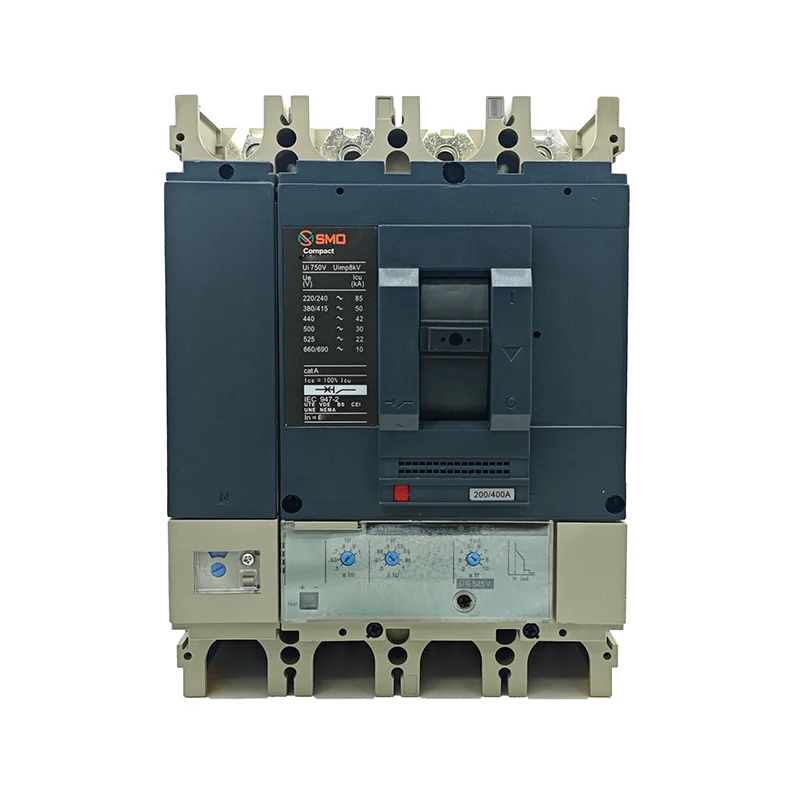
Final spec: 400 A, 3-pole, Icu 36 kA, Ics 27 kA. That’s a breaker you can install and stop worrying about.
Icu is the maximum fault current a breaker can interrupt once without being destroyed. Ics is the fault current it can interrupt repeatedly and remain in service, usually expressed as a percentage of Icu from 25% to 100%.
Size by Icu first, since it must be at least as high as the prospective fault current at the installation point. Then check Ics: for main incomers and critical loads, choose an Ics of 75% or 100% of Icu so the breaker keeps working after a fault.
Anything from 25% to 100% is compliant with IEC 60947-2. Higher is better where service continuity matters. A 100% ratio means the breaker can clear its full rated fault and remain serviceable.
Ask your utility or panel designer for a short-circuit study. The level depends on the transformer size and impedance, cable lengths, and motor contribution. If no study exists, use a conservative estimate.
Yes. It clears the fault once, and that may be all that happens for years. The trade-off shows up after a real fault, when the breaker needs replacement and the circuit stays down until you have a spare.
Three things to remember: Icu is the one-shot limit, Ics is the service rating, and both must be matched against a real fault current number, not a guess. When in doubt, take the next step up. A 36 kA breaker costs about the same as a 25 kA breaker and shrugs off a fault the smaller one cannot survive.
WZSMO builds molded case circuit breakers from 100 A to 1600 A, tested to IEC 60947-2, with breaking capacities matched to transformer and feeder conditions. For lighter distribution panels, the SNS 100A-250A series is a common starting point; motor circuits often step over to the ST-5N 400A. Send us your transformer size, feeder length, and load details, and we will help you confirm the breaking capacity for every position in your panel, or get a quote for your next project.