AC Contactor MOQ and Lead Time: Import Order Checklist
Published: Author: Rachel
Most guides about buying from a Chinese factory stop at how to choose the supplier. This one starts where those guides end: the purchase order has been agreed, and the next six weeks decide whether the shipment arrives as specified or arrives with a problem nobody can fix from the other side of the world.
Below is the order-to-delivery sequence for AC contactors, covering what actually sets the AC contactor MOQ, how lead time splits between production and paperwork, what to lock down on the order confirmation, what to inspect before the container is sealed, and how to handle packaging and documents so the goods clear customs without a second delay.
What Actually Sets the AC Contactor MOQ
MOQ is not a policy a salesperson invents. For contactors it comes out of three production realities, and knowing which one is driving your number tells you whether it can be negotiated.
Driver
Why it sets a floor
Can it move?
Production batch per frame
Assembly is organised by frame, not by order. A small run still occupies the line for a setup cycle.
Partly — a factory may merge your quantity into an existing batch of the same frame
Coil voltage and type
A standard 24 V DC coil is wound in volume; a 110 V 60 Hz coil is a separate small run
By choosing a stock voltage, usually without extra cost
Private label and packaging
Nameplate printing, marking and inner-box artwork each carry a setup
Only by accepting a higher quantity, since the setup is amortised across units
If the frame size is not yet settled, the SMO-K selection guide works through current, duty and coil options before any quantity is discussed.
The practical consequence: if your quantity is below one batch and you do not need private label, ask whether the frame can be supplied from stock or merged into a scheduled run. That is a different question from “can you lower the MOQ”, and it usually gets a more useful answer.
Where Lead Time Actually Goes
Quoted lead time is usually a single number, which hides the fact that it is made of three parts with very different behaviour.
Material and component lead. Standard frames with stock coils start immediately. A non-standard coil voltage adds a winding run, and a special nameplate adds a print run.
Production and test. Assembly plus the routine test sequence. This part is stable and easy to forecast.
Paperwork and booking. Commercial invoice, packing list, certificate of origin, and the freight booking itself. This is the part that slips, because it depends on third parties.
When a supplier quotes “25 days”, ask which parts are included. A 25-day quote that excludes document preparation is not the same as a 25-day quote that includes it, and the difference shows up as a container sitting at the port while a certificate of origin is being issued.
Reading AC Contactor MOQ and Lead Time Together
These two numbers interact, and reading them separately leads to the wrong order size. A larger quantity spreads the private-label setup across more units and lowers the unit cost, but it also lengthens the production block and ties up capital in stock you may not need for a year.
For a first order from a new supplier, the useful compromise is usually the smallest quantity that clears the private-label setup and still fits one production batch — not the largest quantity the discount table rewards. The second order is the time to consolidate frames and take the volume break, once you know the product behaves as specified in your own panels.
What the Order Confirmation Must Lock Down
Most post-shipment disputes trace back to an order confirmation that was too thin. Eight lines should appear in writing before production starts, because each one is expensive to correct afterwards.
Line
What to state explicitly
Model and frame
Exact frame designation plus AC-3 rated current and rated operational voltage
Coil
Voltage, AC or DC, and whether it is a stock or production item
Poles and auxiliary contacts
3P or 4P, and the exact NO/NC configuration as supplied
Inner box quantity, moisture protection, pallet type, total carton count
Incoterm and port
FOB or CIF, named port, and who books the freight
Documents
Which documents are included and which are quoted separately
Two of these deserve emphasis. The auxiliary contact configuration is the single most common mismatch, because a bare frame plus a separately packed add-on block is not the same shipped item as a factory-fitted block, even though the function is identical. And the private-label scope needs to be specific about position, not just content; the ODM and OEM process sets out which parts carry a one-time setup and which recur per unit — a nameplate printed in the right wording but placed on the wrong face is a rework, not a fix.
Inspecting Before the Container Is Sealed
Inspection is not a formality, and it is not the same as trusting the routine test record. A workable pre-shipment check has four parts.
Quantity and carton count. Confirm the master carton count against the packing list before loading, not after arrival.
Draw a sample across frames, not across the shipment. If you ordered three frames, inspect all three. A shipment that is 95% one frame can look perfect on a random sample.
Check the physical items the documents cannot show. Coil marking against the order, auxiliary configuration, nameplate position and wording, and terminal screw type.
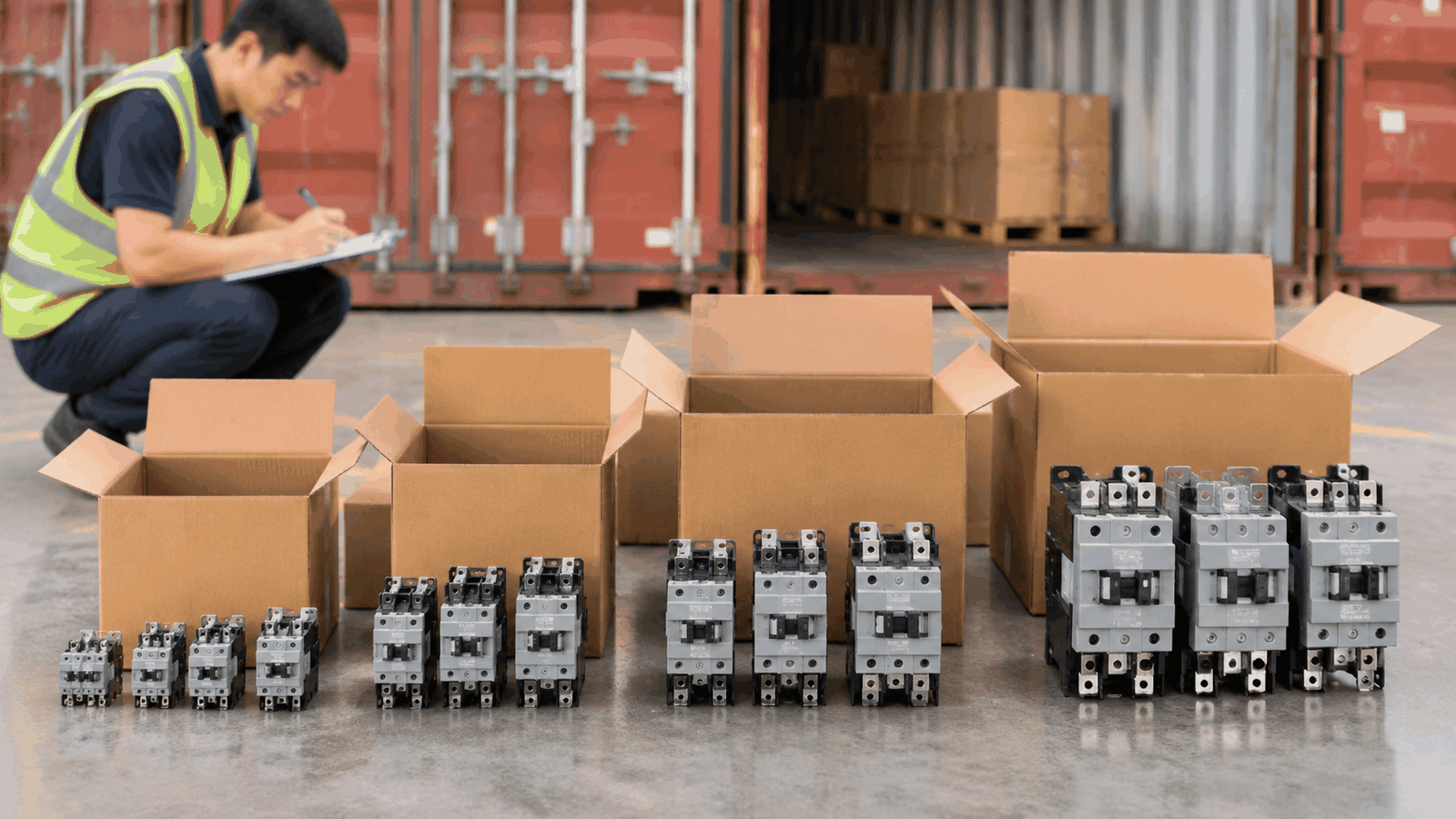
Ask for photographs with the carton open and the units laid out by frame. A photo taken at the factory before sealing is the cheapest evidence you will ever get, and it is difficult to produce retrospectively if the units were never laid out.
If you cannot attend, a third-party inspection is worth the fee on a first order and usually unnecessary afterwards. What matters is that the inspection happens before the container is sealed, because afterwards every correction becomes a claim rather than a fix.
Packaging Decisions That Only Show Up on Arrival
Packaging is where the cheapest savings are made and where the buyer pays for them. Four points are worth specifying rather than accepting the default.
Inner box quantity. A box of ten versus a box of fifty changes handling in your own warehouse, not just freight cost.
Moisture protection. Contactors are not delicate, but moulded cases and terminal plating do not enjoy a humid container crossing the equator. A moisture barrier bag or desiccant in the master carton is inexpensive and rarely offered by default.
Carton strength and stacking. Double-wall cartons on a pallet survive handling that single-wall cartons do not, and the difference only appears as crushed corners at destination.
Pallet configuration. If your warehouse uses standard pallets, confirm the shipped pallet footprint matches. A non-standard footprint means re-palletising on arrival.
Documents, Customs and the Last Mile
The document set for contactors is short, but each item has a failure mode. The commercial invoice must match the packing list exactly in quantity and description; a discrepancy is the most common cause of a customs hold. The certificate of origin is issued per destination and takes time, so it should be requested at order confirmation rather than at shipment. The HS code should be agreed in writing before the order, because a classification dispute at destination is resolved after the goods arrive, not before.
If your customer’s audit requires a specific document package beyond these, say so before the production order is placed. Preparing documents after the goods are packed is possible, but it turns a routine shipment into a rushed one. What ships with each order, and what has to be arranged separately, is set out on the AC contactor supplier page.
When Something Arrives Wrong
Note that this section is about shipment problems, not product faults. If a contactor fails in service after installation, that is a different diagnosis — the AC contactor troubleshooting guide covers the seven faults that account for most field failures.
Shortages and damage are handled very differently depending on when they are discovered, which is why the inspection step above matters more than any clause in the contract.
Shortage found at inspection, before sealing: a production correction. Cheapest possible outcome.
Shortage found at destination: resolved against the packing list and the loading photos, if they exist. Without loading photos it becomes a negotiation.
Transit damage: a freight insurance matter, which requires the damage to be noted at delivery and photographed before unpacking. Once the cartons are opened and moved, the claim weakens.
Specification mismatch: the only one that is genuinely expensive, because it usually means the order confirmation was ambiguous. This is the case the eight-line confirmation exists to prevent.
Frequently Asked Questions
What is a typical MOQ for AC contactors?
It depends on the frame and the level of customisation rather than on a fixed industry number. A standard frame with a stock coil has the lowest floor; private label and non-standard coil voltages raise it, because both carry a setup that has to be spread across the run. Ask which of the three drivers is setting your number — that determines whether it can be reduced.
How long does production take for a private-label order?
Longer than the equivalent standard order, because the nameplate and packaging are produced separately from the contactor itself. The extra time is in the print and setup stages, not in the assembly. Confirm the lead time breakdown in writing, with the paperwork stage listed separately.
Should I attend the inspection or use a third party?
On a first order, either is worth it. The value is not in the inspection itself but in it happening before the container is sealed, while a correction is still a correction. From the second order onward, most buyers rely on loading photos plus a periodic third-party check.
Do I need a certificate of origin before shipping?
If your destination or your customer requires one, it should be requested at order confirmation, because it is issued by an authority rather than generated by the factory. Requesting it after packing is what turns a routine shipment into a delayed one.
What is the most common cause of a shipment dispute?
An order confirmation that left the auxiliary contact configuration or the private-label position unspecified. Both are visible in a photograph and both are expensive to correct after the container has sailed, which is why they belong in writing before production begins.
None of this is complicated, but all of it happens before the goods move, and almost none of it can be fixed afterwards. If you are still choosing between suppliers rather than executing an order, the supplier sourcing checklist covers that earlier stage using the same framework, and the price comparison guide covers how to read the quotation you are about to convert into an order.
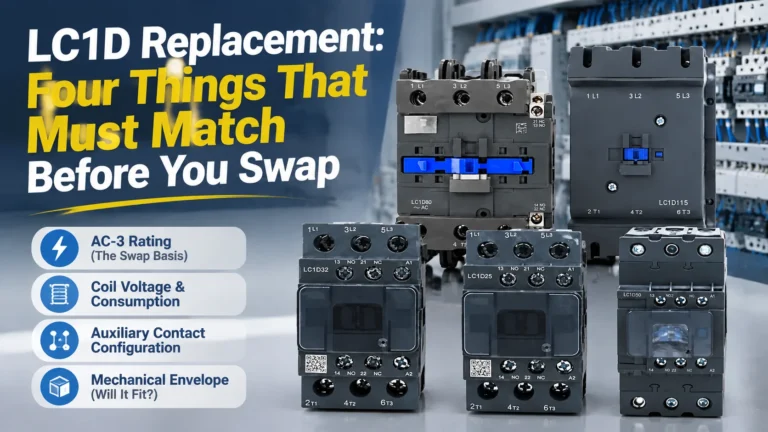
If you are already running LC1D contactors in a panel and looking for a second source, the question is not whether an alternative will fit — most will, physically. The question is which four things have to match before it does, and which of them the datasheet will not tell you. An LC1D replacement guide […]
You send one specification to four suppliers. Three of them quote a 40 A, three-pole AC contactor for a 24 V DC coil. The quotes come back at prices that differ by nearly 40%. Nothing is wrong with your enquiry, and the cheapest supplier is not automatically cutting corners. In most cases the four quotes […]
What an MCB Supplier Should Confirm Before Quoting Miniature circuit breakers are the easiest low-voltage component to order and the easiest to order badly. Unit prices are low, lead times are short, and the range looks simple: a current rating, a pole count, a trip curve. The specification that matters is rarely written on the […]