MCCB Price Guide: How Quotation Is Built from Frame and Capacity
Published: Author: Rachel
What MCCB Price Actually Reflects
Two quotations for molded case circuit breakers can differ by a factor of ten and both be legitimate. The reason is that an MCCB price is not one number. It is a set of variables multiplied together, and most buyers receive quotations that differ in more than one of those variables at the same time. Comparing those two numbers tells you nothing about which supplier is offering better value.
This guide explains how an MCCB price is built, which variables move it most, and how to compare two quotations that do not describe the same product. It also covers where certification, trip unit type and order quantity enter the calculation, and what a realistic lead time looks like at each volume band.
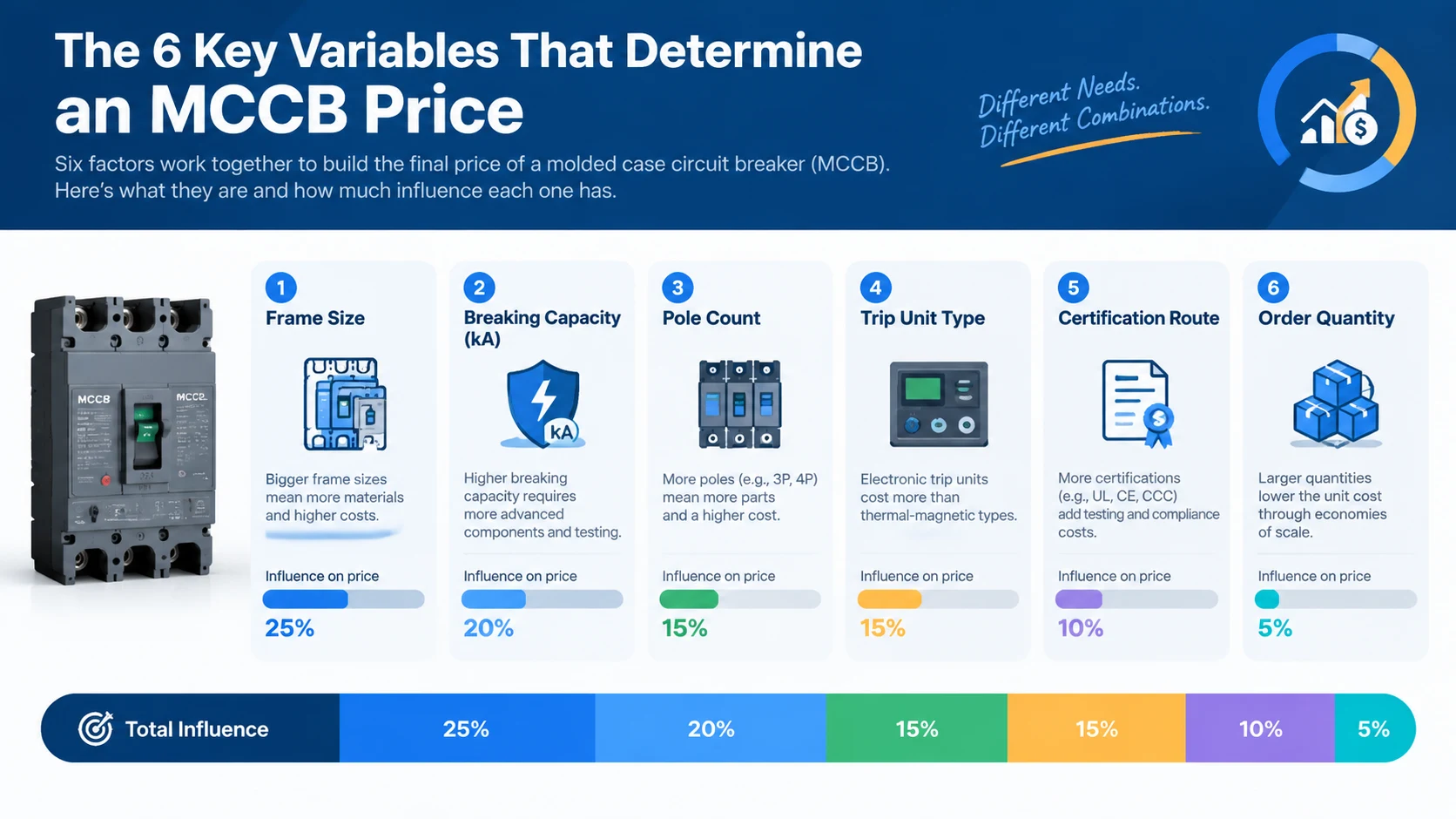
Six variables work together to build the final price, with frame size and breaking capacity carrying the most weight.
The Frame Is the Largest Single Cost Driver
MCCB frame size determines the tooling, the housing, the contact assembly and the busbar cross-section. Frame sizes do not map across brands, so a 100 A device from one series and a 100 A device from another may be entirely different mouldings. That is why two breakers with identical current ratings can sit in very different price bands.
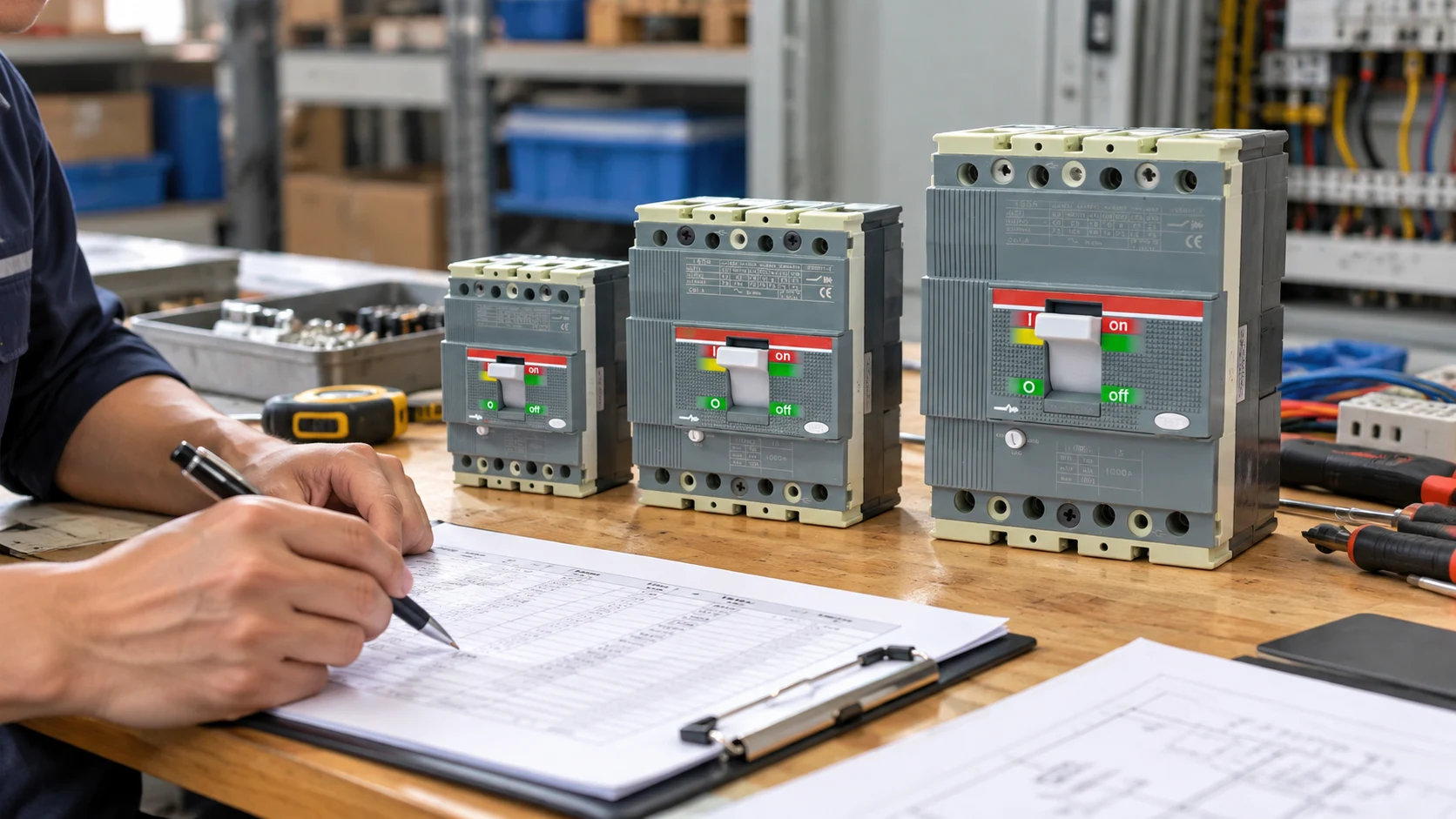
Three frames of the same product family. The physical size difference is the price difference, made visible.
The practical implication is that rated current alone is a weak basis for comparison. Specify the frame size explicitly. Without it you are comparing a device against its own class rather than against an equivalent competitor.
Where the current sits inside the frame
Within a single frame, a low current rating uses less copper in the contact and pole paths, so it costs less than the top of the same frame. The difference is meaningful but smaller than the difference between frames. Buyers who optimise a panel for cost should select the frame that matches the installation requirement rather than stepping up a frame to accommodate a small load variation.
Why the largest frames widen sharply
At the top of the range the cost curve steepens again. The 630 A class involves larger contact surfaces, heavier springs and higher breaking capacity requirements, so the incremental material cost rises faster than the current rating does. This is the band where quotations most often diverge and where a specification error is most expensive.
Breaking Capacity Is the Biggest Step Change
If you remember one thing about how an MCCB price is constructed, remember this: breaking capacity is not a linear increase. Moving from a 6 kA unit to a 25 kA unit in the same frame can add a substantial percentage, while moving from 25 kA to 36 kA adds less again. The curve flattens as it rises.
The commercial designations used across the industry — commonly C, L, M and H — map to progressively higher Icu and Ics limits within a frame. Sellers list an economy tier alongside these higher tiers because the economy version is the one that stays in stock.
This is also where specification discipline pays for itself. If you over-specify breaking capacity, you pay for capacity you will never use. If you under-specify it, the failure mode is a breaker that cannot interrupt the fault it was installed to clear. Our guide to calculating prospective short-circuit current covers how to determine the value you actually need, and how Icu and Ics ratings are defined covers what the numbers mean.
Pole Count and Trip Unit Type Adjust the Total
Adding poles scales the cost roughly in proportion, because each additional pole duplicates the contact assembly and adds housing width. This is the easiest variable for a buyer to control, since it is determined entirely by the installation.
Trip unit type is the more consequential decision. A thermal-magnetic unit uses a bimetal strip and a magnetic plunger. An electronic unit adds circuitry, a display interface and adjustable settings. Electronic units cost more, and for buyers whose customers need coordination flexibility or site-adjustable protection, that premium buys a capability a thermal-magnetic unit cannot provide.
Specify the trip unit before requesting quotations. A thermal-magnetic quotation and an electronic quotation for the same frame are different products and should never be compared directly.
Certification Adds a Stack, Not a Single Premium
Certification cost is cumulative rather than all-or-nothing. A supplier already holding IEC 60947-2 type test evidence for a frame may add CE marking at low cost. Requirements for the United States market — UL 489 in particular — involve a separate certification route that adds materially to the cost of the same device.
Hazardous-area approvals such as ATEX or IECEx represent another tier, and DC-rated devices for solar, battery storage and EV charging command a further premium because the arc extinguishing chamber and trip curve differ from an AC unit in the same frame.
If your quotation does not state which certification route it assumes, it is not yet comparable. Our IEC 60947-2 versus UL 489 comparison sets out what each route involves and why the destination market changes the answer.
How Quantity Changes the Quotation
Unit price and order quantity move in opposite directions, and the relationship is not linear. Small quantities carry disproportionate cost because setup, packaging and minimum order quantities spread across few units. Larger quantities reach the point where material procurement pricing improves.
Two practical points for buyers comparing supplier quotations:
Compare at equal quantity. A unit price quoted at a sample order is not the unit price you will pay for a container.
Ask what the MOQ is per frame size. Suppliers often accept low quantities on stocked frames and much higher ones on custom configurations.
Ask how the quotation handles material movement
Copper is the largest material input in any breaker, and its price moves. A quotation issued at a stated copper reference is worth more than one that is simply “valid for 30 days” with no reference at all.
Two approaches are common. Some suppliers fix the price for the validity period, which transfers the material risk to them and is easier for you to budget. Others quote with a material surcharge clause, adjusting against a published reference. Neither is wrong, but you should know which one you are accepting before you compare the number against another quotation that uses the opposite approach.
This matters most for repeat orders. If the first order was priced with a surcharge clause and you assume the same structure next time, a rising copper price will change your unit cost without any change in specification. Ask directly how the price will be derived at reorder.
Comparing Two Quotations That Are Not the Same Product
Before comparing any two MCCB quotations, confirm that these eight items match. A difference in any one of them explains a price gap, and usually more than one will differ.
The comparison checklist
Frame size — not just rated current
Breaking capacity — the Icu value and whether Ics differs from Icu
Pole count
Trip unit type — thermal-magnetic or electronic
Rated voltage and insulation class — standard or high insulation
Certification route assumed — which approvals are included in the price
Private label status — own label, or customer label with tooling cost
Quantity and Incoterm — EXW, FOB, CIF, and the payment terms attached
A price difference that cannot be explained by eight specification items is not a saving. It is an unpriced assumption, and it will surface later as a dispute or a rejected shipment.
How SMO Configures an MCCB Range
Stating our own configuration plainly lets you compare it against the checks above.
Our molded case circuit breaker ranges cover AC 50/60 Hz circuits up to 690 V, with rated currents from 10 A to 630 A across our T, C, N, S, P, E and M series. Insulation classes are 800 V standard and 1000 V high insulation, with impulse withstand of 6 kV standard and 8 kV high insulation depending on series. Both thermal-magnetic trip units with B/C/D curves and electronic trip units with adjustable long-time, instantaneous and short-time delay are available.
Breaking capacity is series-dependent. For example, the SMO-C1 100A–250A MCCB is rated 36 kA Icu at 400 V, while the SMO-T1 100A MCCB sits in the 10 A to 630 A range with 8 kV impulse withstand — two devices in different frames and different capacity bands, so their prices are not comparable. The full molded case circuit breaker range is listed by frame size so you can match the series to the breaking capacity your installation requires.
Configuration options include three-pole and four-pole arrangements, with residual current modules available where overcurrent-plus-leakage protection is required. Enclosures use thermosetting material for temperature and flame resistance, and the operating mechanism is all metal for long-term mechanical stability. Our range is built to IEC 60947-2, with CE, CCC, UL and CSA available, using halogen-free materials compliant with RoHS and REACH.
AC contactors for motor control applications are available as a separate range on the AC contactor category page.
For quotations, send the frame size, pole count, trip unit type, breaking capacity and destination market — that is enough for a comparable number. Private label and packaging requirements are covered on the ODM/OEM page, and requests can go to our contact page. If you are still deciding whether a supplier is credible before comparing numbers, the MCCB sourcing checklist covers the verification steps first.
Questions Worth Asking About Any MCCB Price
Does this price assume my certification route?
A supplier who confirms which approvals are included has understood the question. One who answers “we can do all certifications” has not told you what this quotation covers.
What changes the price between the economy and the higher breaking capacity tier in this frame?
This tells you how the supplier prices capacity, and lets you judge whether the higher tier is worth it for your fault level.
Is the quoted price firm at my order quantity, and at what MOQ?
The answer reveals whether the supplier has priced your actual volume or simply extended a sample-order number.
What is included in private label, and what is charged separately?
Mould tooling, label printing and packaging design are often billed as one-time costs. Getting them itemised prevents surprises at the second order.
How long is the lead time, and what portion of it is custom tooling?
Separate the two numbers. Production lead time and tooling lead time follow different schedules and combining them under one figure usually misrepresents both.
The Bottom Line on Comparing Quotes
An MCCB price is a function of frame, breaking capacity, poles, trip unit, voltage class and certification — multiplied by quantity and shaped by label requirements. Once a buyer controls those variables, most of the apparent price difference between suppliers disappears, because the remaining differences reflect actual quality differences rather than specification mismatches.
Buyers who get the best value are not the ones who find the lowest number. They are the ones who ensure every quotation on the table describes the same device, then compare what remains.
What an AC Contactor Supplier Should Specify Before Quoting An AC contactor looks like a simple device until you order one from an overseas supplier. The catalogue entry shows a current rating and a coil voltage, and that is where most purchasing stops. By the time the shipment arrives, the difference between a usable part […]
What Makes an MCCB Supplier China Evaluation Different Ask a distributor why they buy molded case circuit breakers from China and you will usually get a price answer. Price matters, but it is the least complicated part of the decision. What actually determines whether an import program succeeds is whether the supplier you chose can […]
<p>Shunt trip, undervoltage release, auxiliary contacts and motor operators compared - what each MCCB accessory actually does, when to specify it, and the checklist to order the right one first time.</p>