How to Source MCCB from a China Manufacturer: A Buyer Checklist for Importing
Published: Author: Rachel
What Makes an MCCB Supplier China Evaluation Different
Ask a distributor why they buy molded case circuit breakers from China and you will usually get a price answer. Price matters, but it is the least complicated part of the decision. What actually determines whether an import program succeeds is whether the supplier you chose can prove three things: that the specific model you ordered is certified for your market, that it will arrive in the condition you specified, and that you can get technical answers after the container leaves the port.
Those three problems only exist when the buyer and the factory are in different countries. A local distributor never has to worry about whether the test report covers their exact frame size, because they can drive to the factory. Importing from China means every one of those assumptions has to be verified in writing before you pay.
This guide walks through how to evaluate an MCCB supplier China, what to request before placing a bulk order, and which signals distinguish a real factory from a trading intermediary.
Deciding What You Actually Need Before You Price Anything
Most import disputes trace back to a specification gap, not a manufacturing defect. Before requesting quotations, pin down these six parameters. A factory quoting against an incomplete specification will quote against a guess, and you will pay for the guess.
Frame size and rated current
MCCB frame sizes do not map cleanly across brands. A 100A device from one series may be a different frame from another manufacturer’s 100A, which changes the physical panel cutout and the busbar arrangement. Specify the frame size explicitly rather than relying on the current rating alone. Most Chinese series cover roughly 10A to 630A, with some extended ranges reaching 1600A, so your requirement will normally be inside the available envelope.
Pole configuration
Three-pole and four-pole versions are both widely available. Four-pole is required for neutral switching in specific installations. Confirm which your project needs, because the price difference is meaningful and the lead time differs.
Trip unit type
Two options dominate: thermal-magnetic units with fixed trip characteristics, and electronic units with adjustable long-time delay, instantaneous, and short-time delay settings. If you are building panels for a specific coordination scheme, or serving customers who need adjustable settings, this decision shapes the quotation more than the frame size does.
Rated voltage and frequency
Standard low-voltage MCCB ranges cover 240V, 400V, 415V, 500V, and 690V AC at 50/60Hz. Insulated versions come at 800V or 1000V. Confirm the voltage class you need against the actual installation rather than accepting the standard entry.
Breaking capacity type
This is the single most expensive differentiator. Commercial designations such as C, L, M, and H map to progressively higher Icu/Ics limits within the same frame. A higher breaking capacity rating means heavier arc extinguishing materials and more testing. Before choosing a type, you need the actual prospective short-circuit current at the installation point — see our guide on calculating prospective short-circuit current and how Icu and Ics ratings are defined.
Target market certification route
This determines which test reports the factory should hold for your order. Our article on IEC 60947-2 versus UL 489 covers the certification routes for the US market in detail, but the general rule is: state your destination market when requesting the quotation, because the required documentation changes accordingly.
A quotation is only comparable to another quotation if both were built against the same specification. When specs differ, the cheapest number on the table is usually the one missing the most.
Six Document Requests That Reveal a Real MCCB Supplier China
Any established manufacturer can produce a certificate. The question is whether the certificate covers the specific product you are about to order. Make these six requests before discussing price, and evaluate how quickly and specifically the answers come back.
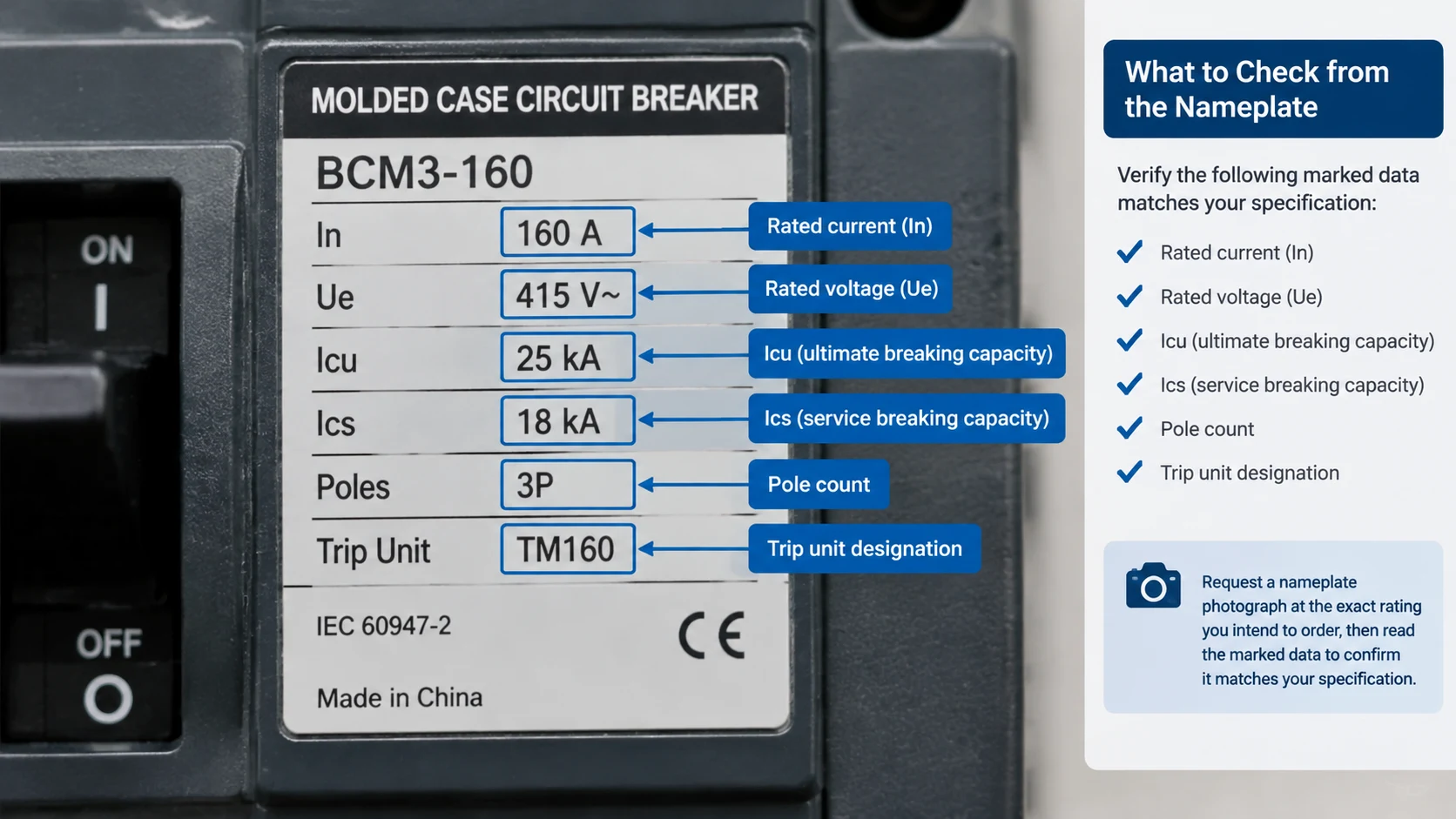
Ask for a nameplate photograph at the exact rating you are ordering, then read the marked data against your specification before production starts.
1. Type test reports with verifiable scope
Ask for the type test certificate number, the issuing body, the standard it references, the model series covered, and the validity period. Then check the critical detail: does the tested range include the frame size and trip unit type you ordered?
Test reports are often issued per trip unit configuration rather than per series. A report covering one electronic trip unit may not extend to the thermal-magnetic version, and a report for one current range may not cover another. This is the most commonly missed detail in imported MCCB documentation.
2. The nameplate photo at the exact rating
Request a photograph of the actual device nameplate for the specific rating, pole count, and breaking capacity type you are ordering. Read the marked data. Confirm the rated current, rated voltage, Icu, Ics, and the trip unit designation all match your specification. This single photo catches a surprising number of mismatches before production starts.
3. Dimensional drawing for panel integration
You need the outline drawing with mounting dimensions, pole spacing, and terminal dimensions. Without it you cannot verify that the device fits your panel cutout, and discovering a dimensional mismatch after the panels are fabricated is expensive.
4. Routine test records rather than a single certificate
A factory that performs its own routine testing will have batch records. Ask to see a recent example and how test data is tied to production batches. Factory experience is valuable, but disciplined in-house testing is what proves the experience is real. Quality documentation that cannot explain the test conditions behind the numbers is a warning sign.
5. Copper and contact material traceability
Ask for material certificates covering the contact alloy and the copper used in the current-carrying path. Contact resistance and terminal strength are the two failure modes most likely to cause overheating in the field. Documentation here should trace back to batch numbers, not just be a generic compliance statement.
6. A written warranty and spare-parts policy
Ask specifically what the warranty period is, what it covers, whether spare parts such as arc chutes, operating handles, and shunt trip units are available, and how long the supplier commits to supplying them. A supplier who cannot answer this in writing has not thought about the ten years after the sale, which is where most of your relationship value will sit.
Fast replies are not the same as engineering support. Ask a technical question twice using different examples, then compare the two answers. Consistent, specific answers matter more than quick ones.
How to Tell an MCCB Supplier China Factory from a Trading Company
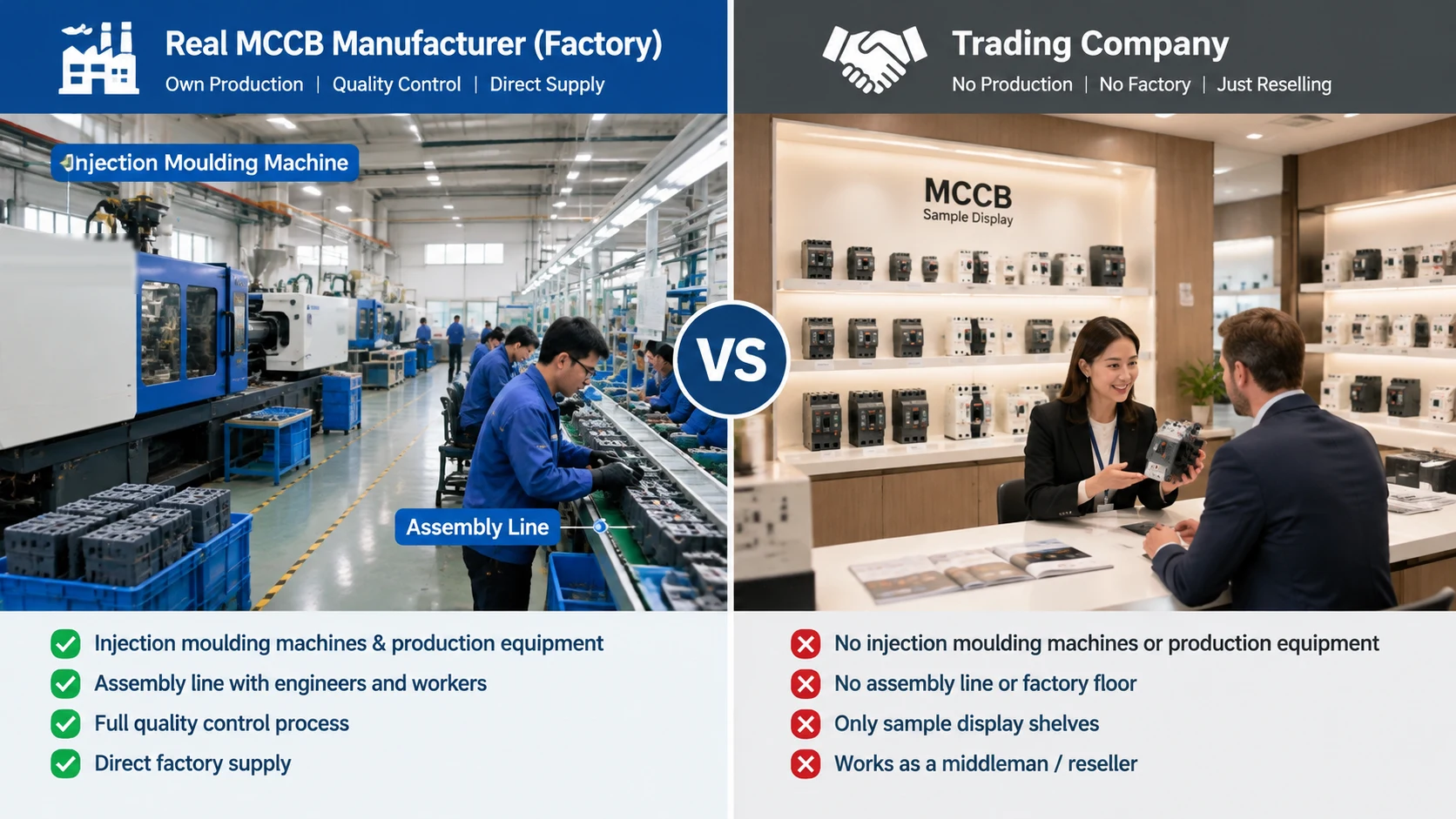
Trading intermediaries are common and legitimate, but a buyer who believes they are dealing with a factory and is not will lose negotiating leverage on quality claims and lead times. Four indicators help separate the two.
Production equipment on one side, display shelves on the other. The equipment test is the quickest way to separate the two.
The catalogue breadth test
Ask what else the company manufactures. A supplier that sells MCCBs, hair dryers, and LED lighting is a trading company. Specialists focus on a defined product family and can discuss the engineering behind their own designs. This is not a moral judgement — you may prefer a trading partner — but you should know which one you are dealing with before you negotiate.
The live video tour test
Request a live video call, not a recorded video. Ask to see the injection moulding area or the assembly line, and ask a question about something only someone on the line would know, such as the most recent tooling change for a frame size. Genuine manufacturers answer. Trading companies show a showroom and move on.
The engineering question test
Ask why a particular series uses one specific design choice — for instance, how the arc extinguishing chamber is arranged or why the operating mechanism is metal rather than plastic. If the answer recites a product listing, you are dealing with a reseller.
The price realism test
Below the raw material cost of copper and silver, something has to be compromised. If a quotation arrives far below any plausible manufacturing cost, ask what changed. Sometimes the answer is simply a smaller frame size or lower breaking capacity, which is fine as long as you know. The problem is not the low price; the problem is a low price that was never reconciled with the specification.
Running a Pilot Order Before Committing to a Full Container
After the documentation review, order samples of the exact frame size and rating you intend to buy. Sample evaluation is where you confirm what the paperwork described.
Sample evaluation confirms what the paperwork described. Check the device in hand, not only the datasheet.
Check the samples for the details documents miss
Moulding quality: inspect the housing for parting-line flash, sink marks, and uniform wall thickness
Terminal strength: confirm the terminal clamp geometry matches the specified cable size range
Internal mechanism: for destructive test samples, break one open and examine contact thickness and the arc chamber layout
Label quality: verify the label is laser-printed and permanent rather than a low-adhesion sticker that will degrade in service
Action mechanism: operate it repeatedly and confirm the mechanism is independent of the housing for positioning
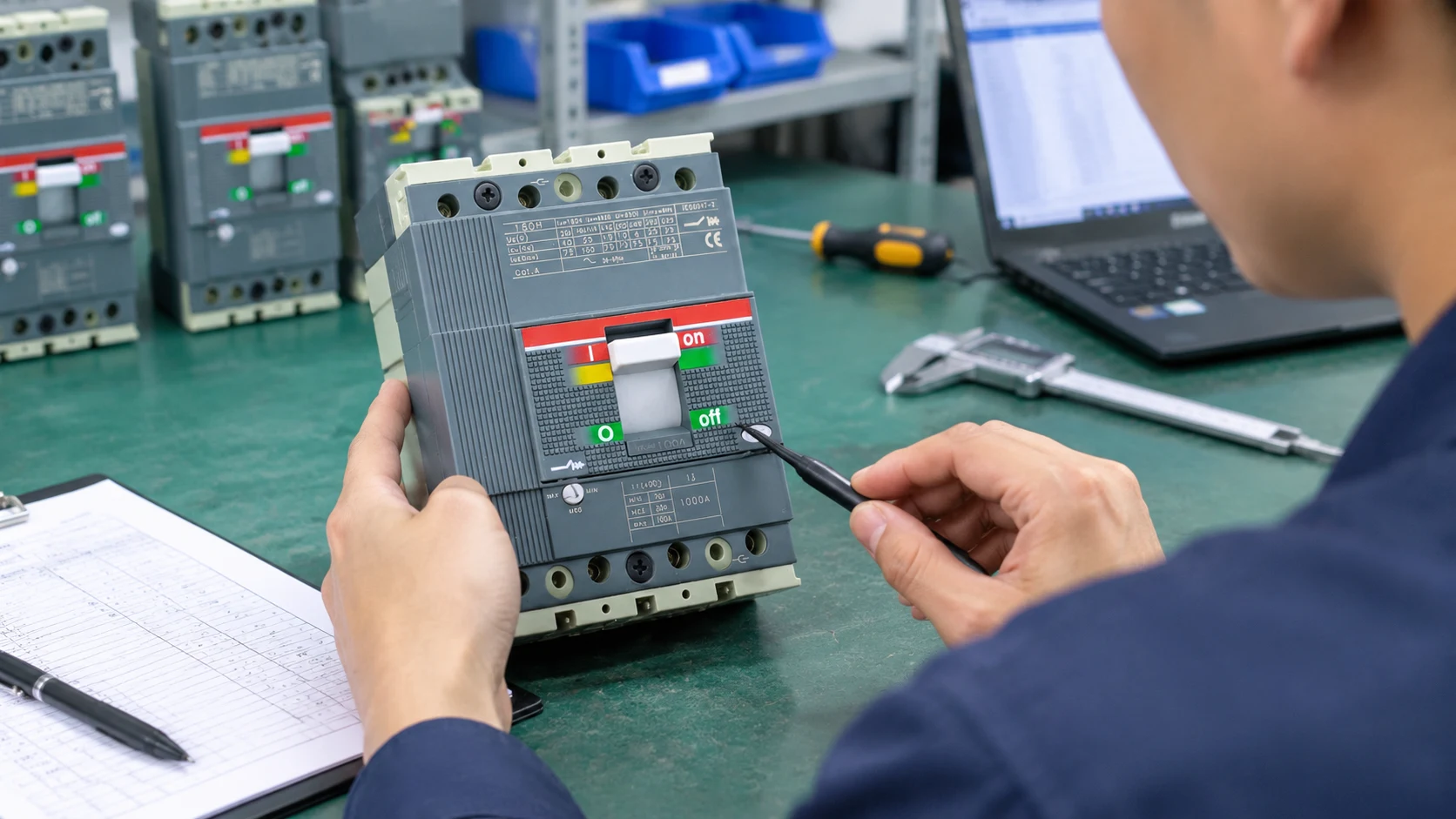
A metal operating mechanism that positions independently of the moulded housing gives better long-term mechanical stability than one that depends on the housing maintaining its geometry. On frames from this category you would typically see the all-metal construction rather than a mechanism relying on the plastic shell.
Use the pilot to test the supply chain, not just the product
A pilot order reveals packaging damage risk, label consistency, and how the supplier handles a correction request. It also reveals how long they actually take. Suppliers who quote 45 to 60 days for a bulk order but promise immediate dispatch on custom configurations are telling you something about their production schedule.
A pilot order is the cheapest insurance in the entire sourcing process. It exposes packaging problems, label inconsistencies, and delivery delays while the cost of walking away is still small.
What to Negotiate Alongside Price
Once the specification is matched and the supplier has proven capable, four terms matter more than unit price for anyone building an ongoing import channel.
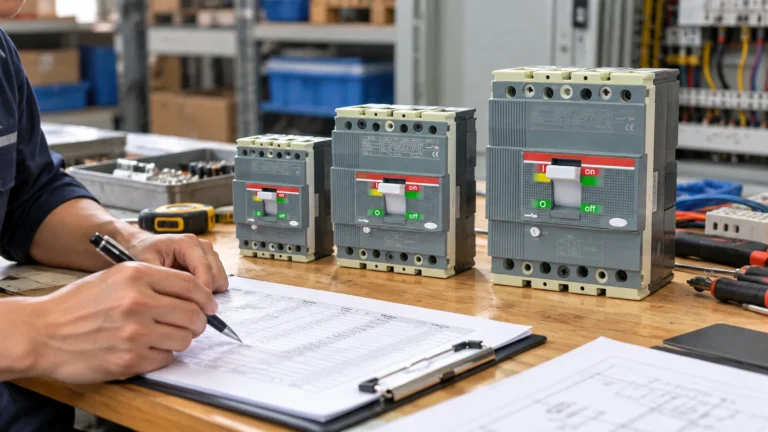
Routine incoming inspection is where batch records come from. Ask to see how a device like this is checked.
Private label and packaging control
If you are building a distribution channel, confirm the brand label, colour scheme, packaging format, and carton markings are yours to control. Also confirm the minimum quantity for custom branding, since this is where flexibility varies most between factories.
Private label lead time and change control
Custom tooling for moulds and labels carries its own timeline. Get that timeline in writing separately from the production lead time, and confirm who bears the cost if a label design needs revision.
Payment terms that match your risk exposure
T/T in advance is common for first orders, with L/C or other arrangements becoming available for repeat business. The pattern matters: the first order carries the most risk for you, so the payment structure should reflect that rather than moving to favorable terms before the factory has proven anything.
Spare parts and technical support commitments
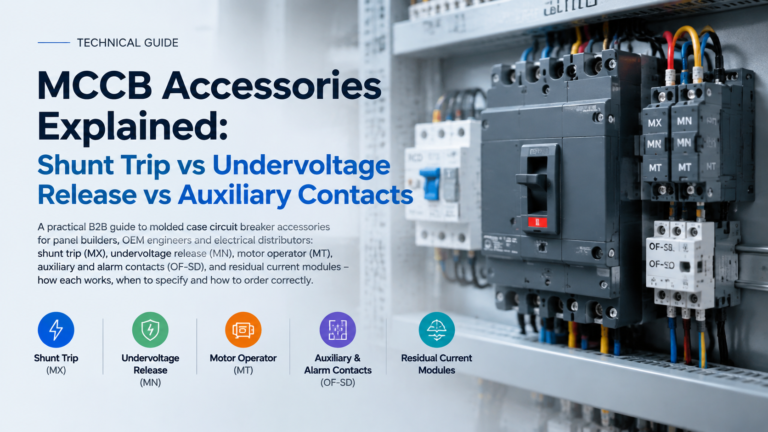
Accessories such as shunt trip units, undervoltage releases, auxiliary contacts, and motor operators should be available alongside the main product. The MCCB accessories overview explains what each accessory does, which helps you specify a coherent accessory set rather than ordering mismatched parts later.
How SMO Configures an MCCB Program
Since you are evaluating sourcing options, here is how our own MCCB range is configured, stated plainly so you can compare it against the verification steps above.
Our molded case circuit breaker ranges are built for AC 50/60Hz circuits up to 690V, covering rated currents from 10A to 630A across our T, C, N, S, P, E, and M series. Standard insulation classes are 800V and 1000V with 8kV impulse withstand voltage. Both thermal-magnetic trip units (B/C/D curves) and electronic trip units with adjustable long-time, instantaneous, and short-time delay are available.
Configuration options include three-pole and four-pole arrangements, and residual current modules can be added where overcurrent-plus-leakage protection is required. The enclosures use thermosetting material for temperature and flame resistance, and the operating mechanism is all metal for long-term mechanical stability. Full range details are on the molded case circuit breaker category page, with frame sizes from 100A up through 630A documented individually — for example the SMO-T1 100A MCCB and SMO-C1 100A–250A MCCB.
On compliance, our range is built to IEC 60947-2 with CE, CCC, UL, and CSA certifications available, using halogen-free materials compliant with RoHS and REACH. If your target market requires UL 489 specifically, raise that during the quotation stage so the correct certification route is quoted — the standards comparison article sets out what that involves.
AC contactor products are available as a separate range for motor control applications, covered in the AC contactor category.
For OEM and ODM requirements — private label, custom packaging, or documented technical support — the ODM/OEM page describes the process. Engineering questions and quotation requests can go straight to our contact page; sending your target market, frame size, pole count, trip unit type, and required breaking capacity gets a far more useful response than a general enquiry.
The Questions Worth Asking Before You Sign
What documentation will you provide for my exact model and frame size?
A good answer names the certificate numbers and confirms the scope covers your rating. An evasive answer defers to “our certifications are complete.”
Which parts of the breaker are your own manufacture?
This reveals whether you are dealing with a manufacturer or an assembler buying cores and housing from others. Either can work, but the price and the quality control leverage differ substantially.
Can you show me a recent routine test record tied to a production batch?
Confident manufacturers produce one immediately. Those without in-house testing capability usually change the subject.
What is the lead time for my configuration, and how much of that is production versus custom tooling?
If custom branding is required, separate these two numbers. A supplier who quotes one blended figure may be optimistic about the part you care about.
If I send a sample for evaluation, how long does that take and what will you test?
A supplier who responds with a defined test plan understands the verification process. One who treats it as a formality is not applying it to your order either.
How do you handle a non-conformance found after shipment?
This reveals whether the warranty is a real commitment. Ask what process applies, what evidence you need to provide, and what remedy is offered. The answer tells you how the relationship will behave when something goes wrong.
Why This Matters More Than the Unit Price
MCCBs are inexpensive relative to the equipment they protect, but a failure carries consequences far beyond the device cost: downtime, panel rework, and in the worst case a safety incident. Importing adds a long chain between your decision and your delivery desk, which means the quality of your supplier verification is the only real control you have.
The importers who succeed are not the ones paying least per unit. They are the ones who spent an extra week confirming that the test report covered the frame size they ordered, that the nameplate matched the specification, and that the supplier answered a hard engineering question without reaching for a product brochure.
Those checks take far less time than a failed shipment does.
What an AC Contactor Supplier Should Specify Before Quoting An AC contactor looks like a simple device until you order one from an overseas supplier. The catalogue entry shows a current rating and a coil voltage, and that is where most purchasing stops. By the time the shipment arrives, the difference between a usable part […]
What MCCB Price Actually Reflects Two quotations for molded case circuit breakers can differ by a factor of ten and both be legitimate. The reason is that an MCCB price is not one number. It is a set of variables multiplied together, and most buyers receive quotations that differ in more than one of those […]
<p>Shunt trip, undervoltage release, auxiliary contacts and motor operators compared - what each MCCB accessory actually does, when to specify it, and the checklist to order the right one first time.</p>