Termal-Manyetik ve Elektronik Açma Özellikli MCCB: Hangisi Seçilmeli?
Yayın tarihi: Yazar: Rachel
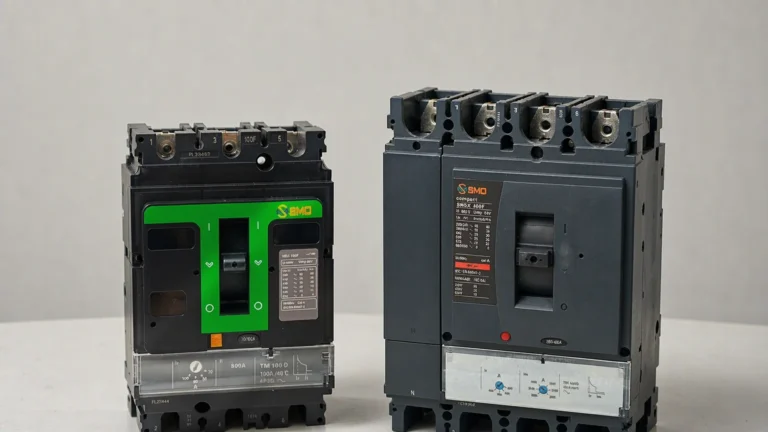
Two MCCBs sit next to each other on a quotation. Same frame, same 36 kA breaking capacity at 415 V, same pole count, same terminal layout. One is priced 30 to 40 percent above the other, and the line that explains the gap is a single word in the description: trip type.
Thermal-magnetic versus electronic trip is usually presented as old technology against new. That framing is not useful for anyone specifying a panel. Both trip types are current products, both are type tested to IEC 60947-2, and both will protect a cable correctly if the device is sized properly. What separates them is a specific list of things one can do and the other cannot — and a set of cost and failure-mode trade-offs that decide which one belongs in your panel.
This comparison works through the mechanism of each trip type, the parameters that actually differ on site, and the cases where the cheaper device is the correct engineering choice rather than a compromise.
Thermal-Magnetic vs Electronic Trip MCCB: The One-Line Difference
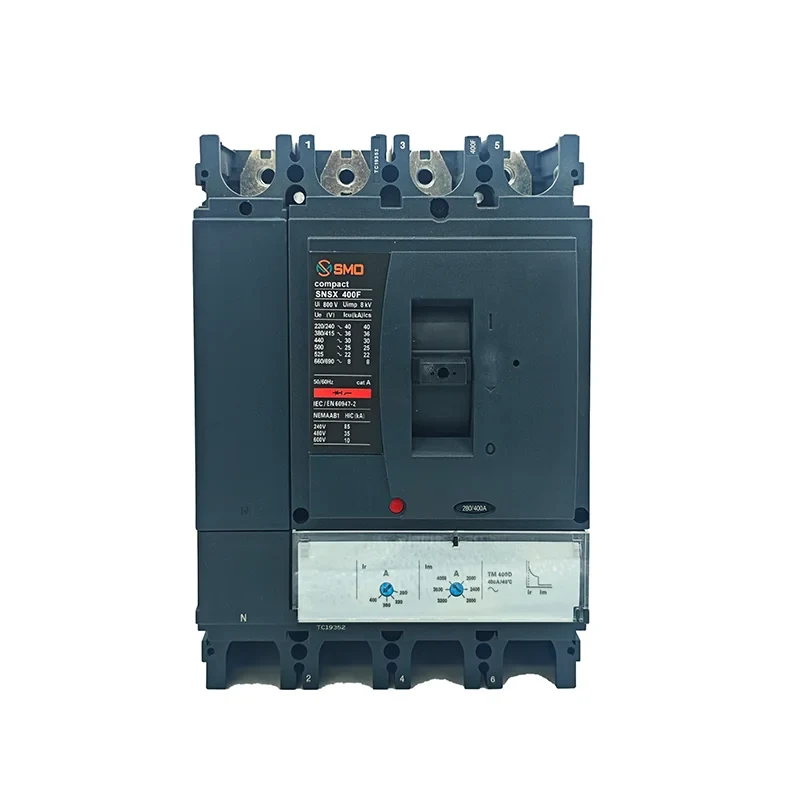
A thermal-magnetic (TM) trip unit is a purely electromechanical assembly: a bimetal strip for overload and a solenoid for short circuit. There is no electronics, no measurement chain and no auxiliary supply — the current passing through the device is the only input it needs.
An electronic trip unit replaces both elements with current transformers, a signal-processing circuit and a low-energy actuator. It measures current, compares it against settings stored in the unit, and releases a latch when a threshold and its associated time delay are exceeded. Because the thresholds are settings rather than geometry, the same physical device can be configured for a range of duties.
Both are governed by the same product standard. IEC 60947-2 requires a device to carry 1.05 times its rated current without tripping and to trip at 1.30 times rated current inside a conventional time — one hour up to 63 A, two hours above it. That is the floor both trip types meet. Everything above the floor is where they diverge.
How a Thermal-Magnetic Trip Unit Actually Trips
The overload element is a bimetal strip heated by the load current, often indirectly through a heating coil. Its deflection is a function of the heating it has absorbed, which is roughly proportional to the square of current multiplied by time. When deflection exceeds a calibrated threshold, the strip releases the latch.
Three consequences follow directly from that mechanism, and all three matter at commissioning:
The curve is fixed by construction. You cannot move the long-time curve without changing the bimetal. Some frames offer an Ir dial that alters the effective setting over a narrow band, but it is a mechanical adjustment, not a programmable curve.
Ambient temperature shifts the trip point. The bimetal is already being heated by the panel, so its trip threshold depends on the temperature around it, not only on the current through it. This is why catalogues publish ambient derating tables rather than a single rated current.
It has thermal memory. A breaker that has been carrying 80 percent of its rating for two hours will trip faster on the next overload than one that has been idle. That is physically realistic behaviour for a cable, and it is also the reason two identical breakers can appear to behave differently on test.
The short-circuit element is a solenoid whose plunger strikes the latch when current exceeds a factory-set multiple of the rating — commonly somewhere between five and ten times In, sometimes with an Im dial to trim it. Above that threshold the device trips with no intentional delay, which is why a TM breaker is a utilisation category A device under IEC 60947-2.
How an Electronic Trip Unit Trips
The measurement chain is the defining feature. Current transformers built into the breaker produce a signal proportional to load current; the trip unit samples it, calculates a true RMS value, and compares the result with the settings. When a threshold is exceeded for longer than its delay, the unit fires an actuator that opens the mechanism.
Because the comparison is arithmetic rather than mechanical, the settings can be expressed as multipliers of the rating and adjusted independently. A typical MCCB electronic trip unit exposes most of the following:
Ortam
What it defines
Typical adjustment band
Ir — long-time pickup
Overload threshold, the continuous current the breaker will carry
0.4 to 1.0 × In, in steps
tr — long-time delay
How long an overload at six times Ir is allowed to persist
A few tenths of a second up to about 24 s, by curve shape
Isd — short-time pickup
Fault current level at which the short delay starts timing
1.5 to 10 × Ir
tsd — short-time delay
Intentional hold time before tripping between Isd and Ii
0 to about 0.4 s, often with an I²t option
Ii — instantaneous
Level above which the breaker trips with no delay at all
1.5 to 15 × In, sometimes defeatable
Ig — earth fault
Residual current threshold, where the function is fitted
0.2 to 1.0 × In
Exact ranges differ between manufacturers and frames — always read the specific trip unit data sheet rather than assuming. But the structure is common, and the important point is that the intentional short-time delay turns the device into a utilisation category B breaker. That single capability is what makes time-graded selectivity possible in a distribution board. Our guide to MCCB açma ünitesi ayarları covers how to coordinate those dials against each other.
Side-by-Side: What Actually Differs on Site
Parametre
Termal-manyetik
Electronic trip
Protection curve
Fixed by construction; narrow Ir band if fitted
Adjustable, independently, per function
Kasıtlı kısa süreli gecikme
None — category A only
Yes — category B, enables time grading
Ambient temperature influence
Direct; the bimetal is part of the measurement
Minimal in the measurement chain; electronics have their own temperature limits
Repeatability after heavy loading
Thermal memory shortens the next trip time
Largely unaffected by prior loading
Earth fault protection
Not available
Available as Ig on many frames
Measurement and communication
Yok
Current, energy and status where the unit supports it
Auxiliary supply
Not required
Not required to trip; often required for display and communications
The extra cost of an electronic trip is not margin. The device carries current transformers sized and classed for measurement, a populated control board, a calibrated actuator, and firmware. Every one of those has to survive the same type tests as the TM version, including the short-circuit test that subjects the interior to a fault at full breaking capacity.
Two effects push back on that price. First, an adjustable unit covers a range of ratings, so a distributor can hold one frame instead of four. Second, adjustability sometimes lets you stay on a smaller frame: if the calculated load sits at 160 A and the next frame up is a 250 A TM unit with a fixed 250 A curve, an electronic 250 A unit set to Ir = 0.64 does not help — but an electronic unit on a 160 A frame that can be trimmed upward later often removes the need to buy a bigger breaker for a design margin that may never be used.
Where the arithmetic genuinely changes is when the alternative is a larger TM breaker plus cable sized for its fixed threshold. A curve you can move is often cheaper than copper. The factors that build an MCCB quotation are worth reading before comparing two offers on price alone.
Ambient Temperature and Derating: The Real Differentiator
In a panel, the breaker sits inside an enclosure that is warmer than the room. A TM breaker’s bimetal is already partly deflected at 55 °C ambient before any load is applied, so its effective rating falls. Catalogue derating tables quantify this, and the correction is not small — a device carrying its full rating at the reference ambient may be limited to roughly 80 percent of that at 55 °C, depending on frame and manufacturer.
An electronic trip unit measures current with transformers, so the trip decision is largely independent of the temperature around it. That does not remove the derating question, and it is a common misreading of the datasheet:
The cable, the terminals and the busbar still derate with temperature. The breaker is not the only hot element in the chain.
The electronics have their own operating temperature range, and above it the unit may reduce its own accuracy or refuse to communicate.
The current transformers have a defined accuracy class. At currents well below the rated range, the measured value is less certain, which is why low-load accuracy is a question worth asking rather than assuming.
So electronic trip removes one variable from the thermal equation. It does not remove the enclosure temperature calculation. If your panel runs hot, you still need the derating exercise described in our guide to choosing the right MCCB.
Where Thermal-Magnetic Still Wins
There is a large part of the market where a TM breaker is the correct specification and an electronic unit is simply more device than the job needs:
Small feeder and sub-distribution circuits. Below roughly 250 A, the fault levels are usually low enough that ratio-based discrimination with fuses or smaller breakers works without adjustable delays.
Motor circuits with a defined starting profile. A dedicated motor protection device handles overload; the breaker’s job is short-circuit protection, and a fixed magnetic threshold set above the starting current does that job with nothing to mis-set.
Hot, dirty or high-vibration locations. No control board means no conformal coating question, no firmware, and nothing to fail from long-term heat exposure inside the enclosure.
Panels maintained by non-specialists. A breaker with no settings cannot be left with Ir at 0.4 after a maintenance visit.
Price-driven distributor ranges. Where the end customer compares on the shelf price of a 100 A three-pole device, a TM unit is the only commercially viable option.
Where Electronic Trip Is the Only Sensible Answer
The inverse list is shorter and more absolute. Choose electronic trip when any of the following is true:
You need selectivity between an incomer and its outgoing devices. Time grading requires an intentional short-time delay on the upstream device. A category A breaker cannot provide it, whatever its ratio.
The load will change over the life of the installation. A building whose tenancy or process load is not fixed benefits from a curve that can be re-set without replacing hardware.
Earth fault protection is required at the incomer. The Ig function is only available on electronic trip units.
The panel is part of a monitored system. Current, power and trip-cause data come from the trip unit, not from a separate meter.
The frame is large. Above roughly 630 A, the thermal element of a TM breaker becomes physically large and its accuracy less certain, while the cost gap narrows as a proportion of device price.
What Neither Trip Type Can Fix
Both trip types are frequently asked to compensate for errors made elsewhere in the design. They cannot.
A correctly set electronic trip unit will not rescue a breaker whose breaking capacity is below the prospective fault current at its terminals. Icu and Ics selection is a separate calculation with its own inputs. Nor will either trip type protect a cable that is undersized for the load, because the cable’s sustained limit and the breaker’s long-time curve have to be coordinated deliberately.
Conversely, a TM breaker is not automatically less safe than an electronic one. It is a type-tested protective device with a defined curve, and when the curve suits the load it is as reliable as anything on the market — arguably more so in an enclosure that runs at 60 °C.
Specification Checklist
Before you choose, put these eight items on one line each. They are the questions that decide the answer, and most of them cannot be answered from a price list.
Ürün
What to state
Why it decides the trip type
1. Load and cable
Design current, cable size, installation method
Sets the long-time curve the device must follow
2. Prospective fault current
kA at the device terminals
Sets Icu and Ics, independent of trip type
3. Upstream and downstream devices
Their ratings and trip types
Decides whether time grading is needed at all
4. Required selectivity
Full, partial, or none
Full selectivity upstream normally forces category B
5. Ambient in the enclosure
°C at the breaker, not in the room
Decides how much of the rating survives derating
6. Earth fault
Required at this level, yes or no
Only available on electronic trip units
7. Monitoring
Any need for current, energy or trip cause
Points to electronic, or to a separate meter
8. Maintenance capability
Who adjusts settings, and how often
A curve nobody can set correctly is a liability
Sık Sorulan Sorular
Can I replace a thermal-magnetic MCCB with an electronic one of the same frame?
Physically, usually yes if the frame, pole count and terminal arrangement match. Electrically, you must re-check the settings: an electronic unit shipped at Ir = 1.0 will not reproduce the curve of the TM device it replaces unless you set it to the same effective pickup, and the short-time delay must be set to zero or coordinated, otherwise downstream discrimination changes.
Does an electronic trip MCCB need a control power supply?
Not to trip. Most units are self-powered from their own current transformers above a threshold current, typically a fraction of the rating. Auxiliary supply is normally needed for the display, communications and sometimes for earth-fault functions when the load current is too low to self-power the electronics. Confirm the self-powering threshold with the supplier if the circuit can run at very light load.
Which is more accurate at low overload?
The electronic unit is more repeatable, because its threshold is arithmetic rather than mechanical. However its accuracy at very low current depends on the current transformer range, so a unit rated 250 A is less precise at 30 A than a smaller frame would be. A TM breaker is less repeatable but its bimetal responds to real heating, which is the quantity that actually damages a cable.
Is electronic trip worth it below 250 A?
Rarely on protection grounds alone, because fault levels and discrimination requirements at that size are usually modest. It becomes worthwhile when the same panel also needs earth fault at the incomer, or when the load is genuinely uncertain and you want to defer the final rating decision.
Can a thermal-magnetic incomer be selective with electronic outgoing devices?
Generally no, and the direction of the mismatch matters. Selectivity needs the upstream device to delay; a category A breaker has no intentional delay to give. The workable arrangement is the reverse: electronic upstream, thermal-magnetic or smaller electronic downstream, with the short-time settings graded. Check the manufacturer’s selectivity tables rather than relying on current ratios alone.
For the range itself, including frame sizes, pole configurations and the trip options available, see our moulded case circuit breaker range.
A 250 A frame carrying 160 A looks like a mistake on a drawing. It is usually the opposite: it is what happens when someone has read the catalogue properly and separated three numbers that a datasheet prints side by side and that a lot of specifications still treat as one. The three numbers are […]
250 A’lık kalıplı gövdeli devre kesici, 250 A akım taşımaz. Bu akımı, tip plakasında açıkça belirtilmeyen belirli koşullar altında taşır: belirtilen ortam hava sıcaklığı, cihazın çevresinde engelsiz hava akışı, dikey olarak monte edilmiş tek bir devre kesici ve konveksiyonu kısıtlayan herhangi bir muhafaza olmaması. Bu koşullardan herhangi biri değişirse […]
Bir panelde yan yana iki adet MCCB bulunmaktadır. Her ikisi de 250 A'lık gövdelidir, her ikisi de 415 V'ta 36 kA nominal akıma sahiptir ve her ikisi de aynı katalog sayfasından alınmıştır. Birinin üç kutuplu, diğerinin dört kutuplu. Fiyat farkı ilginç olan kısım değil. Cevaplanması gereken soru, o dördüncü kutup herhangi bir işlev görüyor mu, […]