

DOL vs Star-Delta vs Soft Starter: Choosing a Motor Starting Method
<p>Direct-on-line, star-delta and soft starters compared on starting current, torque, mechanical stress and cost - with the four questions that decide it.</p>
En savoir plus French
An MCCB on its own does one job: it opens when current exceeds a limit. That is enough for a simple feeder, but it is rarely enough for a panel that has to talk to a PLC, drop on an emergency stop, or refuse to close after a voltage dip. The moment you need the breaker to respond to a command ou report its state, you are specifying accessories.
Accessory specification is also where projects quietly lose weeks. The breaker arrives on schedule, the panel build starts, and then nobody can wire the status feedback because the auxiliary contact was never ordered — or a shunt trip shows up when the design actually needed an undervoltage release. This guide separates the three accessories that get confused most often, then covers the rest of the accessory family and what to confirm before you order.
Accessories are modules that mount inside or onto the breaker and add a function the protection device itself does not provide. They divide into two groups by what they act on.
The distinction matters because the two groups fail in opposite directions. A command device wired wrongly causes a nuisance trip. A signalling device wired wrongly causes a silent one — the SCADA screen keeps showing “healthy” while the feeder is open.
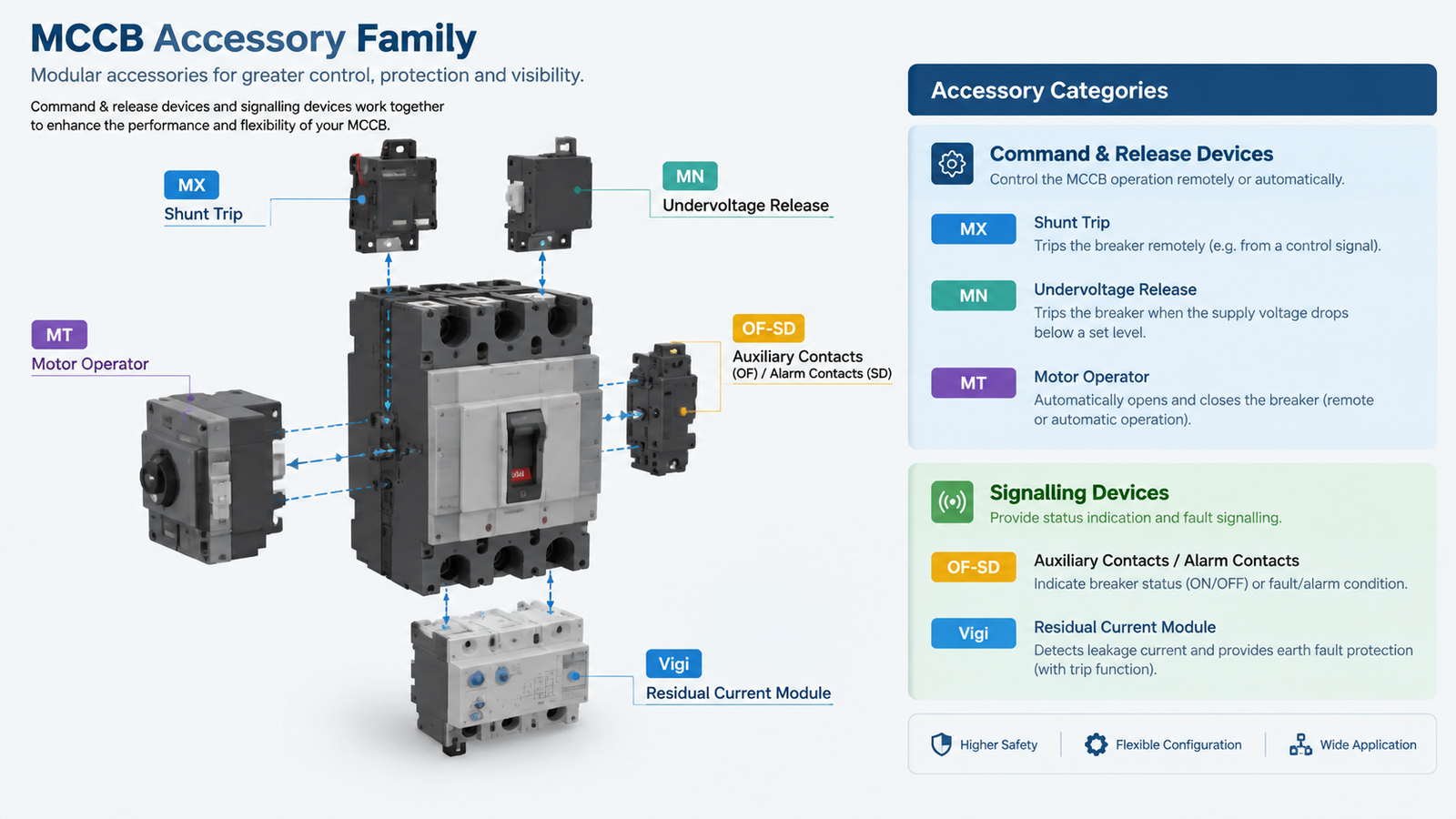
A shunt trip is a release coil that mechanically unlatches the breaker when it is energised. Apply the rated control voltage to the coil, the plunger strikes the trip mechanism, and the breaker opens — regardless of what the load current is doing.
Use a shunt trip when an external system must deliberately open the breaker: emergency stop circuits, fire alarm interfaces, PLC or BMS shutdown sequences, load-shedding schemes, and generator changeover logic. In each case the intent is “an intelligent device decided this should open now.”
A shunt trip is not a generic coil. It is matched to a specific breaker family and frame. Before ordering, confirm the exact breaker model or frame, the required control voltage et whether it is AC or DC, whether the accessory is factory-fitted or field-installable, and the control source that will command it. “I need a 24 V shunt trip” is not a specification — several accessory families share that nominal voltage and none of them are interchangeable.
An undervoltage release works on the opposite logic. Its coil is continuously energised during normal operation, and the breaker physically cannot be latched closed unless the coil is energised. Let the supply to that coil collapse and the breaker opens — or refuses to close in the first place.
Typical operating bands are quoted as a range of nominal voltage, commonly around 70% to 35% Un: above the upper threshold the breaker can be closed and held; below the lower threshold it is released. The exact thresholds are product-specific and must be read from the accessory datasheet, not assumed.
This is the most common misapplication. An MN is a voltage-supervision device, not a fast trip device. Its operating time is slower and less repeatable than a shunt trip, and it depends on the supply it is monitoring. An emergency stop needs a shunt trip — a device that fires when told to, immediately.
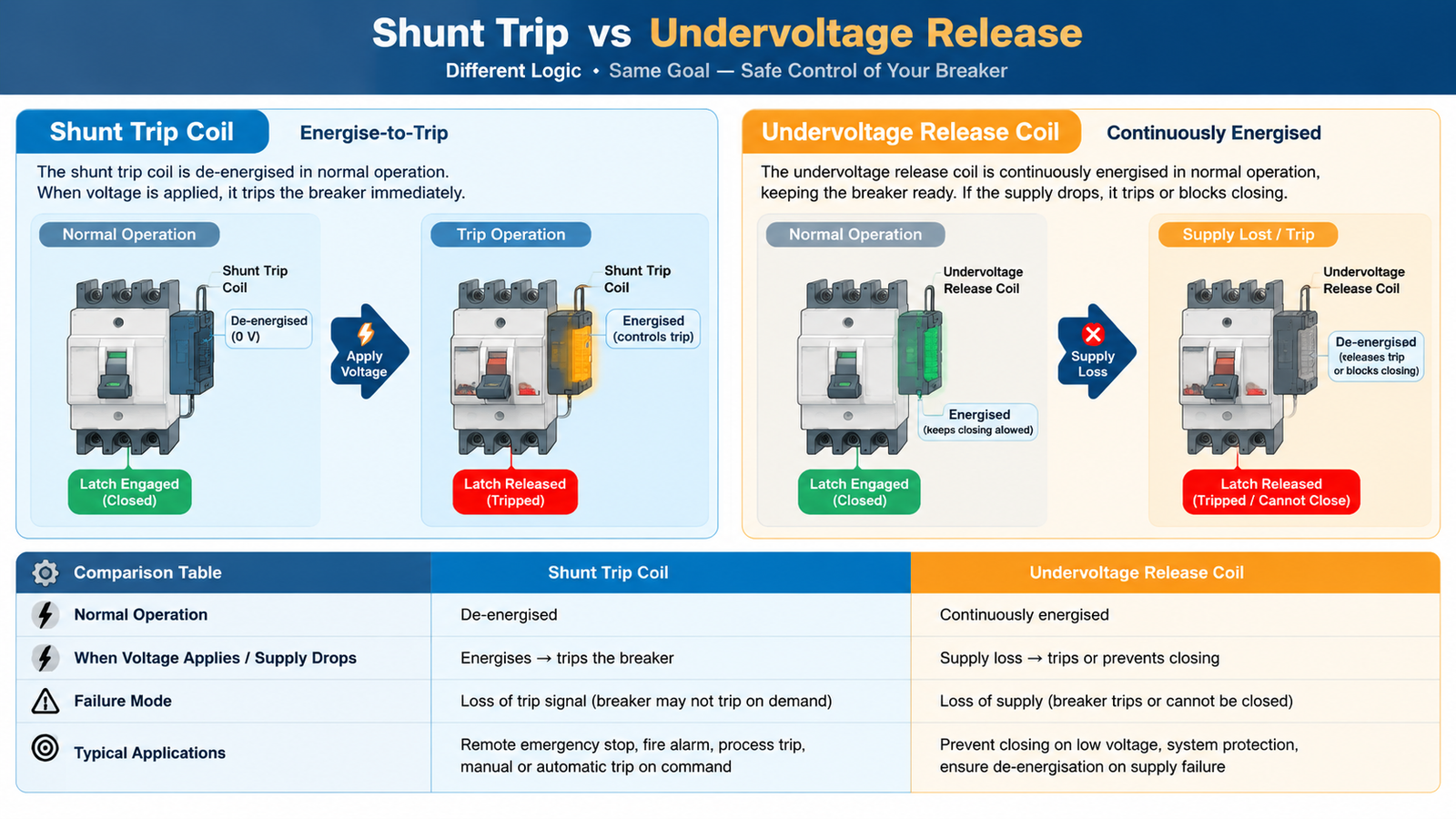
| Question | Shunt trip (MX) | Undervoltage release (MN) |
|---|---|---|
| Coil state in normal operation | De-energised | Continuously energised |
| What makes it open the breaker | Control voltage applied | Coil supply lost or collapsed |
| Can the breaker close if the coil has no supply? | Yes | No — closing is blocked |
| Failure mode if the control wire breaks | Breaker stays closed, command is lost | Breaker trips (fail-safe) |
| Utilisation courante | E-stop, fire alarm, PLC/BMS command, load shedding | Brownout protection, anti-restart, safety interlocks |
| Speed and repeatability | Fast, intended as a trip command | Slower, intended as supervision |
| Behaviour after a supply dip | No action | Opens and requires deliberate reclose |
A useful shorthand: the shunt trip acts, the undervoltage release supervises. If the requirement is “something must open this breaker on purpose,” specify MX. If the requirement is “this breaker must never stay closed when its control supply is unhealthy,” specify MN. Many panels legitimately need both — an MX for the shutdown command and an MN for the interlock — which is why large breakers offer accessory slots for each.
These two are constantly conflated, and they report different things.
That difference is the entire reason to fit an SD contact. Without it, a SCADA system cannot distinguish “an operator racked this feeder out for maintenance” from “a cable faulted at three in the morning,” because in both cases the OF contact says “open.” A typical feeder specification is 1 NO + 1 NC auxiliary contact plus 1 SD alarm contact.
Contact ratings are small — these are signalling devices. They switch control-circuit currents into PLC inputs, indicator lamps and relay coils, and they must never be wired to interrupt a power circuit.
A motor operator adds a small motor that recharges the closing spring and can open or close the breaker on command. It is what you need for remote or automatic operation, and for installations where recharging by hand after every trip is impractical. Motor operators are generally offered on larger frames and are the accessory that makes unattended or remotely managed switchgear possible.
A rotary handle is the mechanical counterpart: a door-mounted operator that lets you work a breaker mounted deep inside an enclosure, usually with a defeatable interlock and a padlocking facility for lock-out/tag-out.
For earth-leakage protection above what a plug-in RCD handles, add-on residual current modules mount to the breaker and provide adjustable sensitivity and delay. The delay is what allows coordination with downstream RCDs — the upstream module waits long enough for the device nearest the fault to clear first. If your project needs earth-fault protection integrated with the breaker rather than as a separate device, this is the accessory to specify. See our overview of residual current protection for how the detection principle works.
| Item | What to confirm | Why it decides the order |
|---|---|---|
| Exact breaker identity | Manufacturer, series, frame, model reference | Accessories are family-specific; they do not cross series |
| Required function | Remote command, voltage supervision, signalling, or remote operation | Prevents MX / MN / MT / OF-SD mix-ups |
| Control supply | Voltage, AC or DC, and source | Coil variants are product-specific |
| Fitment | Factory-fitted or permitted field installation | Not every accessory is retrofittable in the field |
| Contact configuration | Number of NO / NC auxiliaries and whether an SD is needed | Accessory slots are limited per frame |
| Interface | Relay, PLC, BMS or alarm panel, at functional level | Confirms the command or signal path is real |
| Documentation | Target market, required approvals, test certificates | Requirements vary by market and by project |
Often yes, provided the frame offers the slots and the combination is listed by the manufacturer. It is a common arrangement: the MN handles the safety interlock and anti-restart function, and the MX handles deliberate remote shutdown. Confirm the permitted combination in the accessory catalogue for your specific frame.
No. The shunt trip coil is supplied from the control circuit and is independent of the main circuit voltage. You select the coil by control supply — for example 230 V AC, 24 V DC or 110 V DC — not by the breaker’s power rating.
Because the MN coil must be energised before the closing mechanism can latch. If the coil supply is missing, wired to the wrong voltage, or connected to the load side instead of the supply side, the breaker will refuse to close. This is correct behaviour for the device, not a fault.
An auxiliary contact (OF) follows the main contact position and only says open or closed. An alarm contact (SD) operates only on a protective trip. You need the SD if your monitoring system has to distinguish a fault trip from a manual opening.
No. Accessories are matched to a breaker family and frame, and compatibility is defined by the manufacturer’s accessory table. Always order against the exact breaker model rather than a generic description.
The cheapest time to decide on accessories is the moment you size the breaker. At that point the frame is still open, the slot count is still negotiable, and the control philosophy is still on the drawing board. Retrofitting later means a second order, a second lead time, and sometimes a second breaker.
If you are building a panel and want a single order that covers the breaker, the releases and the signalling contacts, send us the breaker model, the control voltage and the functions you need. Talk to our engineering team and we will confirm the compatible accessory set for your frame.