MCB Supplier Guide: How to Specify a Circuit Breaker Range
Published: Author: Rachel
What an MCB Supplier Should Confirm Before Quoting
Miniature circuit breakers are the easiest low-voltage component to order and the easiest to order badly. Unit prices are low, lead times are short, and the range looks simple: a current rating, a pole count, a trip curve. The specification that matters is rarely written on the quotation, which means a buyer can accept several thousand pieces and discover the problem on the cartons.
This guide covers what an MCB supplier should confirm with you before pricing, how to build a specification list that makes quotations comparable, and how to check the goods when they arrive. The focus is on the purchasing decision, because by the time you are comparing quotations the technical choices have largely been made upstream.
This guide is written for buyers evaluating an MCB supplier, not for engineers specifying protection. If you have not yet settled on a supplier, our MCCB sourcing checklist covers the verification steps that come before this stage.
Why MCB Purchasing Differs from MCCB Purchasing
A molded case circuit breaker is a single high-value decision inside one panel. An MCB is a volume decision spread across hundreds of panels, and the total cost is dominated by how the units are packed, labelled and consolidated rather than by the unit price alone.
That difference changes what a supplier should be asked. For MCCB the conversation is about breaking capacity and certification. For MCB the conversation is about pole configuration mix, trip curve, carton quantity and how the pieces fit a container. A supplier who answers an MCB enquiry with a unit price and nothing else has not understood the order.
Pole Configuration and How It Drives the Order
MCBs are supplied in one, two, three or four pole versions. The pole count multiplies the number of pieces you receive for any given quantity of circuits, and it changes the physical width of the DIN rail mounting footprint.
The practical consequence for buyers is that “one thousand MCBs” is an incomplete description of the order. Whether that means 1,000 single-pole units or 250 four-pole units changes the carton count, the container loading plan and the unit cost per circuit significantly.
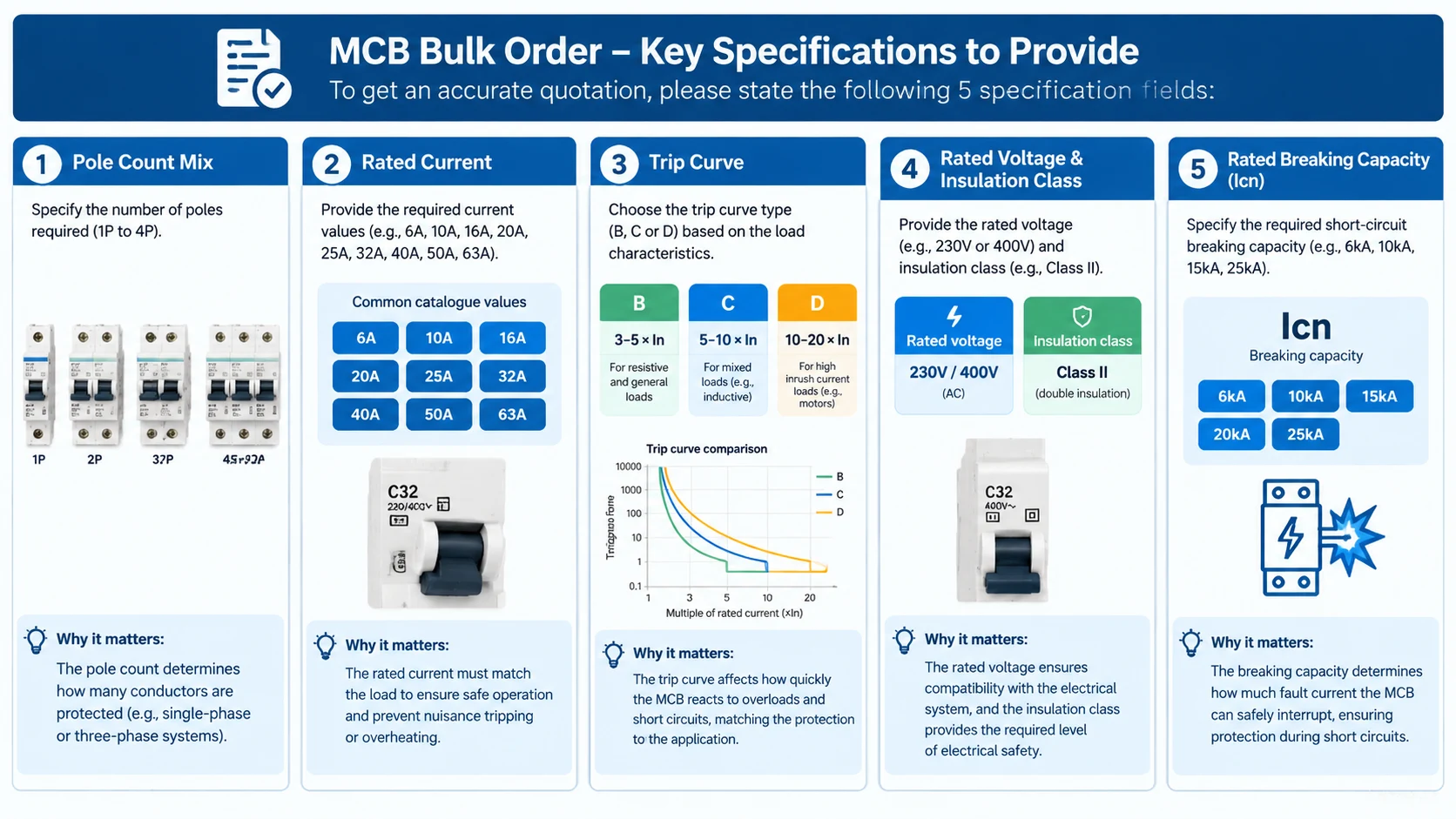
Pole count is the field that changes most about an MCB order. The same circuit quantity arrives in a different number of pieces depending on it.
Ask for the mix broken out by pole count
A useful quotation itemises the delivery by pole count rather than giving one blended number. If a distributor orders a mixed pallet, the breakdown tells you whether the supplier is pricing real demand or averaging a generic quantity. It also tells you whether they can actually assemble a mixed order, which is common in panel building and less common in catalogue sales.
“One thousand MCBs” without a pole count is not a specification. It is a quantity, and quantities are not comparable.
Trip Curve Selection and Where Buyers Get It Wrong
The trip curve describes when the breaker opens relative to its rated current. Curves are typically designated with letters, and the common ones are B, C and D. The letter is not a brand preference; it changes the magnetic trip threshold and therefore which loads the breaker suits.
A buyer who specifies a curve without reference to the connected load will eventually receive a breaker that trips nuisance on a motor starting circuit, or one that fails to protect a resistive circuit properly. This is a technical choice, but it is also a purchasing decision because a returned batch is a written-off batch.
Confirm the curve is available across your current range
Curves are frequently specified per rating rather than per series. Ask whether the curve you need is offered across the whole current range you intend to order, or only for part of it. Suppliers that quote a curve without confirming this often substitute a standard curve on the production run, which changes the delivered product from what was ordered.
Rated Current and the Ranges That Are Actually Available
MCB current ratings are set by the IEC standard series, and a supplier’s catalogue is built from those values rather than from a continuous range. Buyers requesting an unusual current value are either quoted the nearest standard rating or quoted a special price.
Ask the supplier to state the available rated current values in their range, rather than describing it as “up to X amps”. The difference matters when you are building a distribution board with a specific mix of circuits: you need to know which values you can actually order.
Rated current range is not the same as continuous adjustment
A range such as 1 A to 63 A describes the set of catalogue values available, not the ability to set any current within that range. These two statements are easy to confuse in a quotation. Confirm which specific ratings are production-standard and which require a special order.
Rated Voltage, Insulation Voltage and Breaking Capacity
Three ratings are marked on an MCB and they are not interchangeable. Rated operational voltage is the voltage the breaker is designed to switch in service. Rated insulation voltage is the withstand level of the internal insulation. Rated breaking capacity is the fault current the device can interrupt at the stated voltage.
The breaking capacity value matters most when the installation’s prospective fault current is high. A 6 kA device installed on a system where the available fault current is higher will not reliably clear a genuine short circuit.
Both of our MCB series are rated for 6 kA at 230 V and 400 V AC, with 500 V insulation and 230 V / 400 V operational voltage at 50/60 Hz. If your installation needs a higher breaking capacity, say so during the enquiry rather than accepting the standard value and discovering the limitation at commissioning. Our guide to calculating prospective short-circuit current covers how to establish the value you need.
Compliance Standards Buyers Should Check
Miniature circuit breakers for consumer and general installation are covered by the IEC 60898 series, while industrial applications fall under IEC 60947-2. Both appear together on many catalogues because the product family serves both markets.
When you request documentation, confirm which of the two standards the test evidence covers, and confirm that the tested current range includes the ratings you are ordering. A certificate covering a series does not automatically cover every rating within it.
Five fields to state in the enquiry. Leaving any of them open turns the order into an assumption the factory makes for you.
How SMO Configures the SMO-B1 and SMO-B2 Ranges
Stating how our own MCB supplier configuration looks lets you check it against the points above.
The SMO-B2 series is our high-performance MCB for terminal power distribution protection. It is rated 1 A to 63 A, available in 1P, 2P, 3P and 4P, with manual control type, 500 V insulation rating, 230 V / 400 V operational voltage at 50/60 Hz, and 6 kA breaking capacity at 230 V and 400 V. Compliance is to IEC 60898-1 and IEC 60947-2. The B2 also supports a wide range of optional accessories for functional expansion.
The SMO-B1 series is the universal industrial-grade MCB intended for industrial control, power distribution cabinets and medium-load commercial distribution, and is tested 100% before shipment.
Across both series, the customisable items are rated current, pole count, tripping curve, silk screen printing and packaging. That covers the specification fields discussed above except breaking capacity, which is fixed per series.
For bulk enquiries, send the pole count mix, the rated current values, the trip curve, the destination market and the annual quantity. That is enough for a comparable quotation. Private label and packaging requirements are covered on the ODM/OEM page, and requests can go to our contact page. If you also need to understand how a quotation is built before comparing numbers, our MCCB price guide covers the variables that move the unit cost.
Questions Worth Asking an MCB Supplier
Can you break the quotation out by pole count?
If the supplier cannot itemise the delivery, ask how the mixed order will be assembled and packed. Blended unit prices usually mean blended assumptions.
Which rated current values are production-standard?
Ask for the specific catalogue values. A range quoted as “1 to 63 A” does not tell you whether a specific value such as 32 A is standard or special-ordered.
Is the trip curve I need available across my whole current range?
This is where substitutions happen. A supplier who cannot confirm the curve is available for every rating they quoted may change it at the production stage.
What breaking capacity does this quotation cover?
Ask for the Icn value at the voltage your installation uses. 6 kA at 230 V and 6 kA at 400 V are not always the same number.
Which standards does the test evidence cover?
Ask for the certificate reference and confirm the tested range includes your ratings, not just the series.
What is the carton quantity and the pallet configuration?
This determines how many units fit in a container and therefore what the delivered cost per circuit is. It is a packing question, not a product question, but it changes the total more than the unit price does.
Why This Matters Before the Goods Arrive
MCB orders are usually large in quantity and modest in unit value, so a specification error is not expensive per piece. It is expensive in aggregate, because the correction has to be applied across a full production run and, if the units are already installed, across finished panels.
The five fields covered here — pole count, rated current, trip curve, rated voltage class and breaking capacity — take minutes to state in an enquiry. Confirming them against the carton markings on arrival takes the same time. Getting them wrong costs considerably more than either.
What an AC Contactor Supplier Should Specify Before Quoting An AC contactor looks like a simple device until you order one from an overseas supplier. The catalogue entry shows a current rating and a coil voltage, and that is where most purchasing stops. By the time the shipment arrives, the difference between a usable part […]
What MCCB Price Actually Reflects Two quotations for molded case circuit breakers can differ by a factor of ten and both be legitimate. The reason is that an MCCB price is not one number. It is a set of variables multiplied together, and most buyers receive quotations that differ in more than one of those […]
What Makes an MCCB Supplier China Evaluation Different Ask a distributor why they buy molded case circuit breakers from China and you will usually get a price answer. Price matters, but it is the least complicated part of the decision. What actually determines whether an import program succeeds is whether the supplier you chose can […]