AC Contactor Price: Why Identical Frames Quote 40% Apart
Yayın tarihi: Yazar: Rachel
You send one specification to four suppliers. Three of them quote a 40 A, three-pole AC contactor for a 24 V DC coil. The quotes come back at prices that differ by nearly 40%. Nothing is wrong with your enquiry, and the cheapest supplier is not automatically cutting corners. In most cases the four quotes describe four slightly different products.
AC contactor price differences between nominally identical frames are normal, and they usually trace back to five things: the weight of silver in the contacts, the grade of the moulding compound, the true AC-3 rating rather than the thermal current, the batch size your coil voltage forces, and what the unit price quietly excludes. This article walks through each one, then gives you a comparison sheet you can send to every supplier so the next round of quotes can actually be read side by side.
Why AC Contactor Price Varies by 40% on the Same Frame
The number on the front of a contactor is its thermal current rating, and thermal current is a poor description of what the device can actually switch. Two 40 A frames can carry the same continuous current and still behave very differently when they break a stalled motor, because breaking capacity comes from the arc chute, the contact separation speed and the mass of silver on the tips — none of which appear on the nameplate.
The rating that matters for motor duty is AC-3, defined in IEC 60947-4-1 as switching squirrel-cage motors during normal running. Every serious supplier quotes AC-3. What they do not quote is the margin above it. One factory builds a frame that passes the test with headroom, another builds one that passes with almost none. The second is cheaper, and it will still work — until the panel switches a heavy load many times a day.
That gap in headroom is the single largest reason quotations diverge. It is not sales margin. In practice, two quotations for the same nominal frame regularly land 30–40% apart for this reason alone.
First, Confirm You Are Comparing the Same Device
Before reading prices, check that the four quotes describe the same part. In our experience the most common cause of a “cheap” quote is a specification that quietly differs from the one you asked for.
The four lines that change the part number
Coil voltage and type. A 24 V DC coil and a 220 V AC coil are different products. A 110 V 60 Hz coil is a third product again, and it is rarely held in stock.
Pole count. Three-pole is standard. Four-pole adds a pole, a set of contacts and a wider body, and it is only needed where the neutral must be switched.
Auxiliary contacts. A contactor with a factory-fitted 1NO + 1NC block is not the same item as a bare frame plus a separate add-on block, even though both end up with the same function.
Mounting. DIN-rail clip versus screw fixing changes the base moulding. A quote that assumes one when the panel needs the other is not comparable.
If any of these four lines is missing from a quotation, the price is not yet a price — it is an assumption.
Where the AC Contactor Price Gap Hides
Once you have four quotes for genuinely the same part, the remaining differences come from material. Contactors are a commodity-metal product, which is why their cost tracks silver and copper more than it tracks electronics pricing.
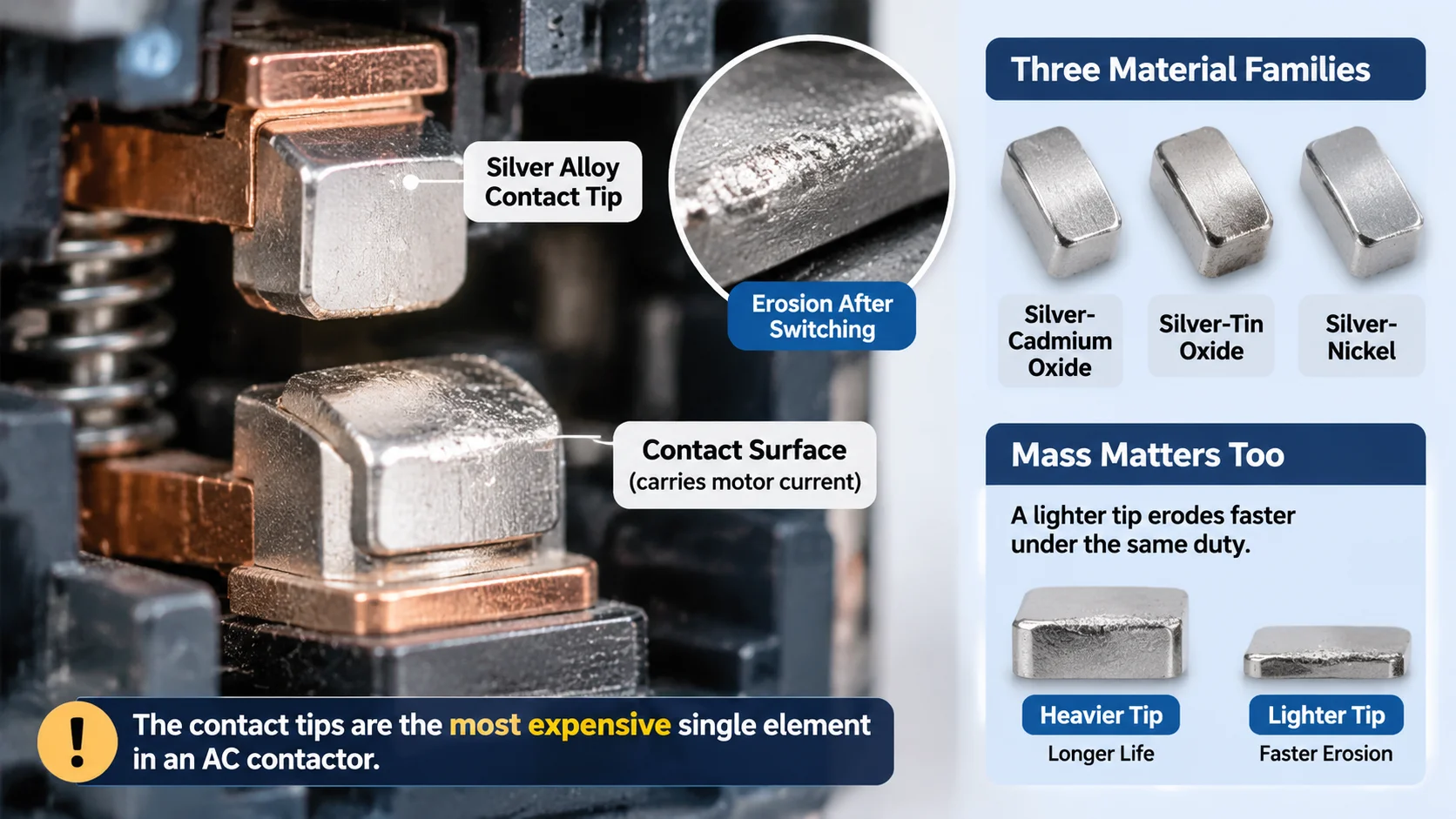
Silver contacts carry a third of the cost
The contact tips are the most expensive single element in the device. Three material families are in use: silver-cadmium oxide (AgCdO), silver-tin oxide (AgSnO₂) and silver-nickel (AgNi). AgSnO₂ has largely displaced AgCdO in Western ranges because of REACH and RoHS pressure, and it is harder to manufacture consistently, which shows up in cost. Some low-cost private-label lines still use AgCdO, which remains legal in some markets but fails procurement rules in others.
Material family is only half of it. The other half is mass. Two contactors rated 40 A AC-3 can carry visibly different silver weight on the tips, and a lighter tip erodes faster under the same duty. Neither figure is printed on the device, which is exactly why it needs to be asked for.
Coil cost is batch size, not material
A standard 220–230 V AC coil is produced in volume for every frame and costs roughly the same wherever you buy it. A 24 V DC coil, a 48 V coil or a 110 V 60 Hz coil is a smaller run, and the price difference reflects the batch, not a better magnet. This is the reasoning behind the coil guidance in our guide to coil voltage and AC-3 rating: choose the coil your control circuit needs, then confirm it is a stock voltage before you assume the price is the supplier’s margin.
Housing grade and mechanism tolerance
The moulded case is usually a glass-filled flame-retardant polyamide. Two suppliers can both describe their housing as flame retardant and still be using different grades with different tracking resistance. Inside, the mechanism sets how far the moving contact travels and how firmly it seats. A mechanism set loose will chatter; set tight, the contactor stops picking up reliably at low control voltage. That adjustment costs assembly time, and assembly time is in the price.
What a Low Unit Price Usually Trades Away
A cheaper contactor is not a defective one. It is a device where one or more of the following has been reduced, and each has a visible consequence in service:
Silver weight on the tips. Shorter electrical life under frequent switching. The contactor still meets its rating when new.
Coil winding and insulation margin. Higher temperature rise in continuous duty, which shortens insulation life in a hot panel.
Mechanism spring quality. Slower or less consistent release, and a higher risk of contact welding after a heavy fault.
Test time per unit. A full routine test on every unit costs minutes, not hours, but minutes are money at volume. Skipping or sampling it is the cheapest saving a factory can make.
Packaging. Thinner inner boxes and no moisture barrier. The damage happens in transit, so the buyer discovers it on arrival.
The last item is worth pausing on, because it is invisible in every quotation. A unit that was never routine-tested can look identical to one that was. This is why the checks each unit goes through before packing are worth asking about directly, and why a supplier who can describe them in sequence is usually the one who actually performs them.
Read the Total Landed Cost, Not the Unit Price
Unit price is the least useful number on a quotation until everything around it is known. Six lines decide whether a cheaper unit is actually cheaper:
Line
What it does to the total
What to ask
Order quantity and MOQ
A factory prices per production batch; a stockist sells any quantity at the top of the range
What is the batch size for my frame, and what is the price at 100, 500 and 1,000 units?
Tooling or setup charge
Applies to private label: nameplate, marking, packaging artwork
Is the tooling charged once, and is it amortised into the unit price above a threshold?
Coil voltage surcharge
Non-standard coils add cost through batch size
Is my coil voltage a stock item or a production run?
Certification scope
Documents for a specific destination market add cost on the affected frames
Which documents are included in this price, and which are quoted separately?
Ambalaj
Inner box, moisture barrier, pallet configuration
Is packaging included, and is export packing the same as the standard pack?
Incoterm
FOB and CIF differ by freight and insurance, not by product
Which port, and is the freight quoted at today’s rate or last month’s?
Two quotations can only be compared when these six lines match. Comparing an FOB price at 1,000 units with a CIF price at 100 units is not a comparison, it is two unrelated numbers. The same logic applies to circuit breakers, which is why the MCCB fiyat kılavuzu on this site uses the same framing for a different product family.
When the Cheaper Contactor Is the Right Buy
Not every panel needs the most expensive frame available, and over-specifying is its own form of waste. A lower-cost contactor is a defensible choice when all of the following are true:
Switching frequency is low. A unit that operates a few times a day will not exhaust its contacts within the equipment’s service life.
The load is genuinely AC-1 or light AC-3. Resistive heating, lighting and small fans do not stress the contacts the way a 30 kW motor does.
It is a spare or a retrofit. Replacing a failed unit on an existing panel is a different decision from designing a new one, and matching what is already installed often matters more than upgrading.
The panel is not in a hot or humid environment. Where ambient temperature is controlled, coil temperature rise has less effect on life.
The inverse also holds. For a motor that starts and stops dozens of times a day, in a panel with poor ventilation, the cheapest frame is rarely the cheapest decision — the replacement cost and the downtime arrive long before the contactor’s rated mechanical life is reached.
A Comparison Sheet You Can Send to Any Supplier
Most of the difficulty in comparing AC contactor prices disappears if every supplier answers the same eight questions. Send this list with your enquiry and the quotes become directly readable.
#
Ask for
Why it matters
1
AC-3 rated current and rated operational voltage for the specific frame
This is the rating to match against your motor, not the thermal current
2
Contact material family and tip weight per pole
The largest single cost element and the main driver of electrical life
3
Coil voltage, and whether it is a stock or production item
Explains a surcharge that otherwise looks like margin
4
Pole count and auxiliary contact configuration as supplied
Prevents comparing a bare frame with a configured one
5
Housing material and flammability grade
Separates quality tiers that both say “flame retardant”
6
Routine test performed on each unit, and what the record contains
Distinguishes tested production from sampled production
7
Unit price at 100, 500 and 1,000 pieces, and the batch size
Shows whether the quoted price is a batch price or a stockist price
8
Documents included, Incoterm, and packaging description
Closes the gap between unit price and landed cost
If you are still deciding which frame you need before asking for prices, the SMO-K seçim kılavuzu works through ratings, coil options and duty cycles frame by frame. If the answer is already settled and you simply need the numbers, send the frame, coil voltage and quantity and the quotation comes back with the model, unit price and lead time rather than a price range.
For buyers adding their own branding, the ODM and OEM process explains which costs are one-time tooling and which are recurring per unit, because that split decides whether a private-label order makes sense at your volume.
Sık Sorulan Sorular
Is a more expensive AC contactor always better quality?
No. Price tracks silver weight, housing grade, batch size and documentation, and a higher price can simply reflect a non-standard coil or a small order quantity on an otherwise ordinary frame. The reliable comparison is AC-3 rating against contact mass and routine-test practice, not price alone.
Why does a 24 V DC coil sometimes cost more than a 220 V AC coil?
Because the DC coil is produced in smaller batches. The materials are not meaningfully more expensive; the factory simply runs fewer of them, and the setup cost is spread over fewer units. A 24 V DC coil is still often the right choice for a panel that already runs a 24 V control circuit, since it avoids adding a separate control transformer.
Does order quantity really change the unit price that much?
Between 100 and 1,000 pieces of the same frame, a meaningful step is normal, because factories quote per production batch. The larger effect for a small buyer is structural: below one batch, a stockist is usually cheaper than a factory, even though the stockist’s unit price looks higher.
Should I compare FOB or CIF prices?
Compare like with like. FOB isolates the product and lets you control freight; CIF bundles freight and insurance at the seller’s chosen rate. If quotes arrive in mixed terms, convert them to the same Incoterm before comparing, and check that the freight rate is current rather than carried over from an earlier quotation.
What should I check on a sample before placing a volume order?
Check that the AC-3 rating matches the quotation, that the coil picks up and drops out cleanly at your actual control voltage, that the auxiliary contacts operate in the configuration you specified, and that the mechanism releases without sticking. Fit the sample into the panel or a mock-up before ordering, because depth and terminal access are the two dimensions that most often differ from the drawing.
None of this requires a laboratory. It requires asking the same eight questions of every supplier and reading the answers against each other. That is usually enough to explain a 40% price gap — and to decide whether it is worth paying.
Most guides about buying from a Chinese factory stop at how to choose the supplier. This one starts where those guides end: the purchase order has been agreed, and the next six weeks decide whether the shipment arrives as specified or arrives with a problem nobody can fix from the other side of the world. […]
If you are already running LC1D contactors in a panel and looking for a second source, the question is not whether an alternative will fit — most will, physically. The question is which four things have to match before it does, and which of them the datasheet will not tell you. An LC1D replacement guide […]
Bir MCB Tedarikçisinin Fiyat Teklifi Vermeden Önce Doğrulaması Gerekenler Minyatür devre kesiciler, sipariş edilmesi en kolay düşük gerilim bileşenleri olmakla birlikte, yanlış sipariş edilmesi de en kolay olanlardır. Birim fiyatları düşüktür, teslim süreleri kısadır ve ürün yelpazesi basit görünür: akım değeri, kutuplu sayısı, açma eğrisi. Önemli olan teknik özellikler nadiren […] üzerinde yazılır.